세상을 바꾼 방정식들
Equations that changed the world
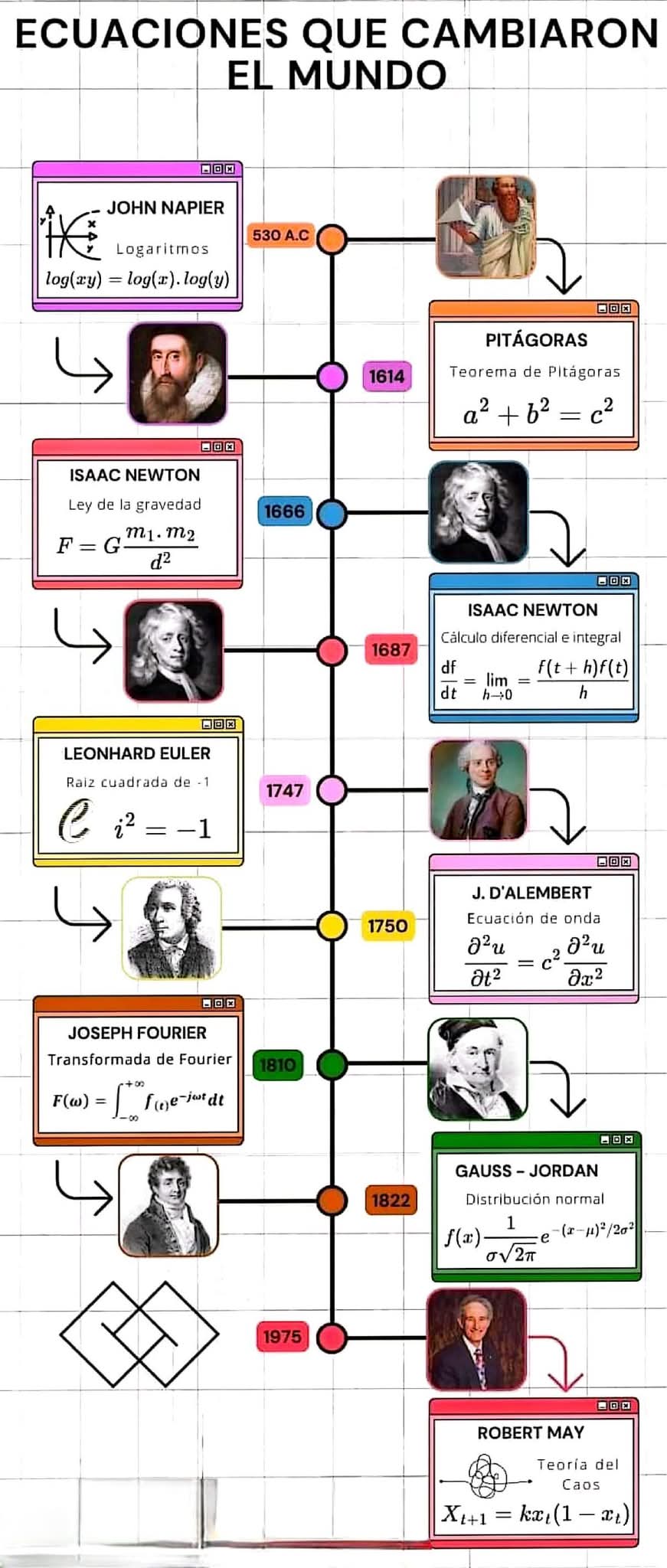
아래 이미지는 수학 역사의 주요 방정식과 그 발견자들을 연대순으로 보여주는 타임라인입니다. 각 방정식은 역사적 중요성을 지니며, 과학과 기술 발전에 크게 기여했습니다.
주요 방정식 및 발견자:
- 피타고라스의 정리 (기원전 530년): 피타고라스는 직각삼각형의 세 변 사이의 관계를 나타내는 유명한 정리 a² + b² = c² 를 발견했습니다. 이 정리는 기하학과 삼각법의 기초를 형성합니다.
- 네이피어의 로그 (1614년): 존 네이피어는 로그를 발명하여 복잡한 계산을 간소화했습니다. 로그의 발명은 과학과 공학 분야의 계산을 획기적으로 발전시켰습니다.
- 뉴턴의 만유인력의 법칙 (1666년): 아이작 뉴턴은 만유인력의 법칙 F = G(m₁m₂)/d² 을 발견하여 중력의 작용을 설명했습니다. 이 법칙은 천체의 운동을 이해하는 데 중요한 역할을 했습니다.
- 미적분학 (1687년): 아이작 뉴턴은 미적분학을 발명하여 변화율과 면적을 계산하는 새로운 방법을 제공했습니다. 미적분학은 과학과 공학의 거의 모든 분야에서 필수적인 도구입니다.
- 오일러의 공식 (1747년): 레온하르트 오일러는 허수 i² = -1 의 개념을 도입하여 복소수 이론의 기초를 마련했습니다. 복소수는 전자기학, 양자역학 등 다양한 분야에서 사용됩니다.
- 달랑베르의 파동 방정식 (1750년): 장 르 론 달랑베르는 파동의 전파를 설명하는 파동 방정식 ∂²u/∂t² = c²∂²u/∂x² 을 유도했습니다. 이 방정식은 음파, 빛, 지진파 등 다양한 파동 현상을 이해하는 데 사용됩니다.
- 푸리에 변환 (1810년): 조제프 푸리에는 푸리에 변환을 개발하여 복잡한 함수를 단순한 삼각함수의 합으로 표현하는 방법을 제시했습니다. 푸리에 변환은 신호 처리, 이미지 처리 등 다양한 분야에서 사용됩니다.
- 가우스-조르단 분포 (1822년): 카를 프리드리히 가우스와 윌리엄 조르단은 정규 분포를 설명하는 가우스-조르단 분포를 개발했습니다. 정규 분포는 통계학과 확률론에서 매우 중요한 역할을 합니다.
- 카오스 이론 (1975년): 로버트 메이는 카오스 이론을 개발하여 비선형 시스템의 예측 불가능성을 설명했습니다. 카오스 이론은 기상학, 생물학 등 다양한 분야에서 사용됩니다.
이 이미지는 수학의 발전 과정을 간결하게 보여주는 시각 자료로, 각 방정식의 중요성과 그 역사적 맥락을 이해하는 데 도움이 됩니다. 각 방정식에 대한 더 자세한 설명은 수학 관련 서적이나 웹사이트를 통해 찾아볼 수 있습니다.
- 피타고라스 (고대 그리스)
- 네피어 로그 (스코트랜드)
- 뉴턴 (영국 링컨셔)
- 오일러 (스위스/러시아 )
- 푸리에 (프랑스)
- 가우스 (독일 괴팅겐)
- 카오스 이론 (May, 1936-, 미국)
This image is a timeline that shows the key equations in the history of mathematics and their discoverers in chronological order. Each equation is historically significant and has greatly contributed to the advancement of science and technology.
Key Equations and Discoverers:
- Pythagorean Theorem (530 BC): Pythagoras discovered the famous theorem a² + b² = c² that describes the relationship between the three sides of a right triangle. This theorem forms the foundation of geometry and trigonometry.
- Napier's Logarithms (1614): John Napier invented logarithms, simplifying complex calculations. The invention of logarithms revolutionized calculations in science and engineering.
- Newton's Law of Universal Gravitation (1666): Isaac Newton discovered the law of universal gravitation F = G(m₁m₂)/d² explaining the action of gravity. This law was crucial for understanding the motion of celestial bodies.
- Calculus (1687): Isaac Newton invented calculus, providing new methods for calculating rates of change and areas. Calculus is an essential tool in almost all areas of science and engineering.
- Euler's Identity (1747): Leonhard Euler introduced the concept of the imaginary number i² = -1, laying the foundation for complex number theory. Complex numbers are used in various fields such as electromagnetism and quantum mechanics.
- D'Alembert's Wave Equation (1750): Jean le Rond d'Alembert derived the wave equation ∂²u/∂t² = c²∂²u/∂x² which describes the propagation of waves. This equation is used to understand various wave phenomena such as sound waves, light waves, and earthquakes.
- Fourier Transform (1810): Joseph Fourier developed the Fourier transform, providing a method to represent complex functions as a sum of simple trigonometric functions. The Fourier transform is used in various fields such as signal processing and image processing.
- Gauss-Jordan Distribution (1822): Carl Friedrich Gauss and William Jordan developed the Gauss-Jordan distribution, which describes the normal distribution. The normal distribution plays a very important role in statistics and probability theory.
- Chaos Theory (1975): Robert May developed chaos theory, explaining the unpredictability of nonlinear systems. Chaos theory is used in various fields such as meteorology and biology.
This image is a visual aid that concisely shows the progression of mathematics, helping to understand the importance of each equation and its historical context. For more detailed explanations of each equation, you can refer to math books or websites.