웹 우주 망원경으로 보는 NGC346
NGC34 Viewed by Web Space Telescope
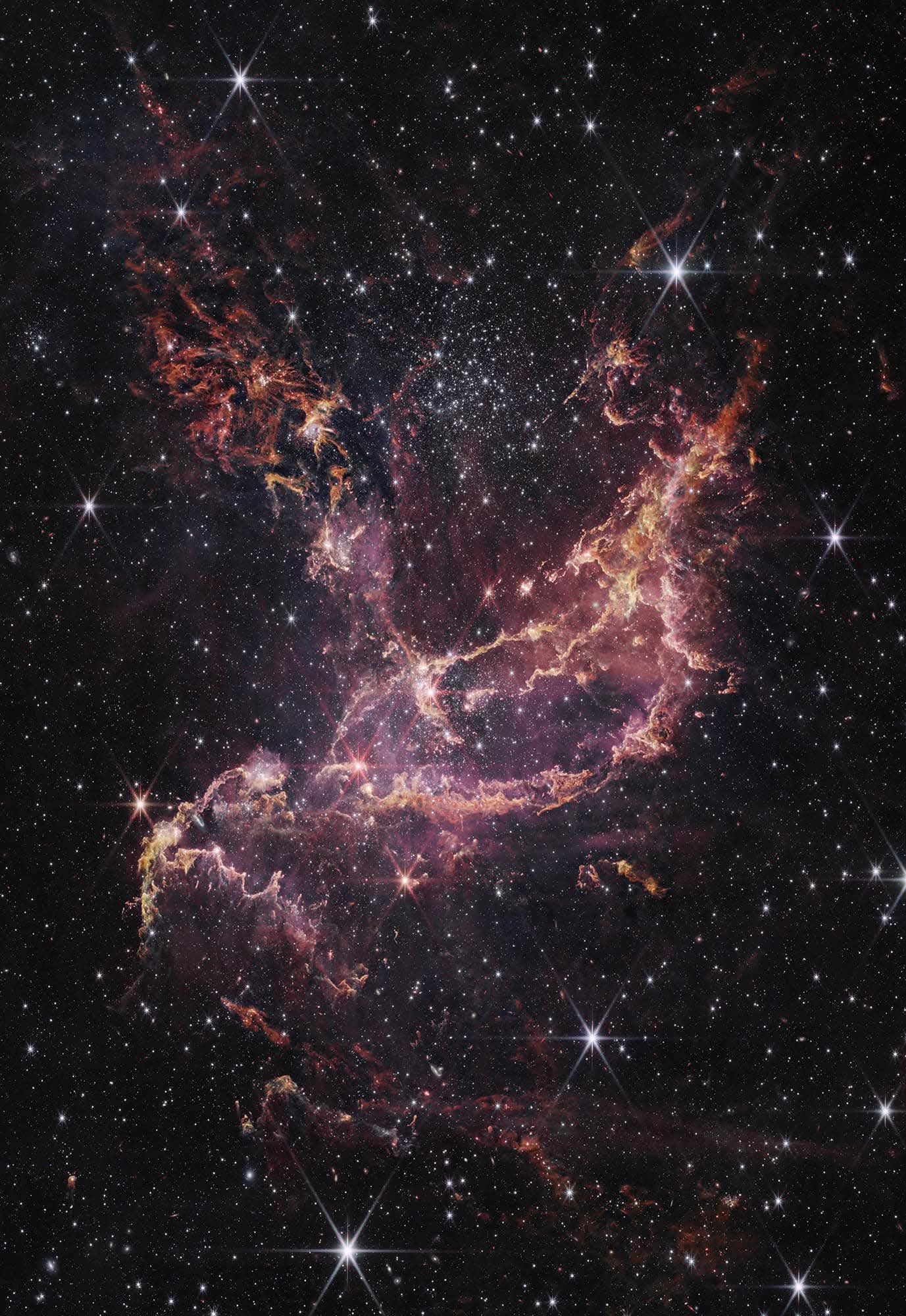
초기 우주에서 별 형성은 어떠했을까요? 먼 과거의 환경을 연구하는 한 가지 방법은 가까운 곳에서 유사점을 찾는 것입니다. 이것이 바로 웹 우주 망원경이 이웃 왜소 은하 내의 별 형성 영역인 NGC 346을 관찰한 이유입니다.
NGC 346은 초기 우주의 은하 조성과 훨씬 더 유사한 조성을 가진 소마젤란운에 위치해 있습니다. 소마젤란운은 별 형성이 최고조에 달했던 시기의 은하와 유사합니다. NGC 346을 관찰함으로써 천문학자들은 멀리 떨어진 은하에서의 초기 별 형성이 어떠했을지 알아낼 수 있습니다.
웹 우주 망원경의 감도는 이전보다 훨씬 작은 원시별(갓 태어난 별)을 볼 수 있게 해줍니다. 망원경은 심지어 이러한 원시별 주위의 가스 원반에 있는 먼지까지 볼 수 있는데, 이는 처음 있는 일입니다! 본질적으로 웹은 별뿐만 아니라 잠재적으로 행성의 구성 요소까지 보고 있는 것입니다. 이는 우리가 생각했던 것보다 더 일찍 우주에서 암석 행성이 형성되었는지 여부를 알아내는 데 도움이 될 수 있습니다.
쉬운한글번역:
What was star formation like in the early universe? One way to study conditions in the distant past is to find parallels close by. That's why Webb took a look at star-forming region NGC 346 within our neighboring dwarf galaxy.
NGC 346 resides in the Small Magellanic Cloud, which has a composition much closer to that of galaxies from the early universe — when star formation was at its peak. By observing NGC 346, astronomers may learn what early star formation in far-off galaxies might have looked like.
Webb’s sensitivity allows it to see much smaller protostars (baby stars) than previously observed. The telescope can even see the dust in the disks of gas around those protostars, which is a first! Essentially, Webb is seeing the building blocks of not just stars, but also potentially planets. This could lead to learning if rocky planets formed earlier in the universe than we thought.
Credits: NASA, ESA, CSA, O. Jones (UK ATC), G. De Marchi (ESTEC), and M. Meixner (USRA), with image processing by A. Pagan (STScI), N. Habel (USRA), L. Lenkic (USRA) and L. Chu (NASA/Ames)
제공: NASA, ESA, CSA, O. Jones (UK ATC), G. De Marchi (ESTEC) 및 M. Meixner (USRA), 이미지 처리: A. Pagan (STScI), N. Habel (USRA), L. Lenkic (USRA) 및 L. Chu (NASA/Ames)
PS:
제임스 웹 망원경의 명왕성에 대한 최종 발견은 우리 모두가 두려워하는 것을 확인합니다.