태양풍과 관련된 태양의 코로나 구멍
Coronavirus holes in the sun associated with solar wind
이미지는 태양풍과 관련된 태양의 코로나 구멍을 보여주는 도표입니다

- 중앙: 이미지는 태양을 노란색 원으로 나타냅니다. 이 원의 표면에는 "코로나 구멍"이라고 표시된 더 어두운 영역이 있습니다.
- 자기장 선: 태양에서 나오는 검은색 곡선 화살표는 닫힌 자기장 선을 나타냅니다. 이 선들은 코로나 구멍 근처에서 다시 태양으로 돌아갑니다.
- 바람:
- 빠른 바람: 푸른색 화살표는 코로나 구멍에서 바깥쪽으로 뻗어 나가며, "빠른 바람"이라고 표시되어 있습니다.
- 느린 바람: 빨간색 화살표는 더 긴 곡선 경로를 따라 태양에서 뻗어 나가며, "느린 바람"이라고 표시되어 있습니다.
- 코로나 스트리머: 태양 주위의 보라색 영역은 코로나 스트리머를 나타내며, 이는 플라스마가 축적된 큰 구조입니다. 이러한 스트리머는 태양에서 멀리 뻗어 나갑니다.
- 스트리머 스토크: "스트리머 스토크"라고 표시된 빨간색 화살표는 코로나 스트리머의 특정 영역을 가리킵니다.
- 열린 자기장 선: 몇 개의 검은색 곡선 화살표는 태양을 떠나 공간으로 뻗어 나가며, "열린 자기장 선"이라고 표시되어 있습니다.
이 그림은 코로나 구멍, 자기장 선 및 태양풍이 태양의 활동과 어떻게 관련되어 있는지 설명합니다.
본문 :
태양은 자연에 단극 자기장이 존재한다는 물질적 증거입니다.
단극 자기 영역은 태양 표면의 뚜렷한 영역으로, 단일 자기 극성을 가지며 증가된 우주선 강도와 상관관계가 있는 것으로 관찰되었습니다. 코로나 구멍은 태양 표면의 영역으로, 단극 자기장을 가지고 있으며 행성 간 공간으로 확장됩니다. 그러나 현재 물리학에서는 코로나 구멍을 자기장 선이 열려 있는 태양 영역으로 간주합니다.
여기서 자기장 선은 실제로 수학적 개념이며 물리적 현실이 아니며, 자기장의 방향과 강도를 나타내는 시각적 보조 도구 역할을 합니다. 즉, 자기장 선은 지도상의 등고선과 유사한 개념적 도구로, 보이지 않는 자기장을 시각화하는 데 도움이 됩니다.
자기장 선은 실제 물리적 현상인 자기장의 연속적이고 일관된 특성을 이해하는 편리한 방법을 제공합니다. 그러나 자연에는 쌍극 자기장과 단극 자기장의 두 가지 유형의 자기장이 존재하며, 쌍극 자기장은 단극 유도 효과를 생성할 수 있고 태양과 같은 소스에서 단극 영역의 기원과 관련되어 있기 때문에 이들 간에는 관계가 존재합니다.
단극 자기장은 존재하며, 고속 태양풍 흐름 및 저속 태양풍 흐름과 같은 태양풍 메커니즘은 단극 자기장의 역할과 태양에 에너지를 공급하는 외부 자기장과의 상호 작용을 인식하지 않고는 이해할 수 없습니다.
Jamal S. A. Shrair, 오스트리아 Villach에 거주하는 반체제 아랍 과학자
Coronavirus holes in the sun associated with solar wind
The image is a diagram showing the corona hole of the sun associated with the solar wind.
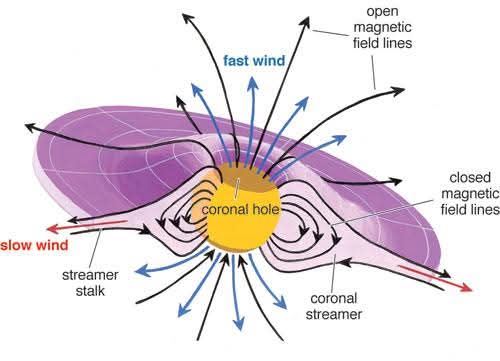
- Center: The image represents the sun as a yellow circle. The surface of this circle has a darker area marked "corona hole".
- Magnetic field line: Black curved arrows from the sun indicate closed magnetic field lines. These lines return to the sun near the corona hole.
- Wind:
- Fast wind: Blue arrows extend outward from corona hole, marked "fast wind".
- Slow wind: Red arrows extend from the sun along a longer curved path, marked "slow wind".
- Corona Streamer: The purple area around the sun represents Corona Streamer, which is a large structure with accumulated plasma. These streamers extend away from the sun.
- Streamer Stoke: Red arrows marked "streamer Stoke" point to a specific area of Corona Streamer.
- Open magnetic field line: Several black curved arrows leave the sun and extend into space, marked "open magnetic field line".
This figure describes how corona holes, magnetic field lines, and solar wind are related to the activity of the Sun.
Text:
The sun is a material proof of the existence of a unipolar magnetic field in nature.
The unipolar magnetic region is a distinct region of the surface of the Sun, with a single magnetic polarity and has been observed to correlate with increased cosmic ray intensity. The corona hole is a region of the solar surface that has a unipolar magnetic field and extends into interplanetary space. However, in current physics, the corona hole is considered a solar region with open magnetic field lines.
Here, the magnetic field line is actually a mathematical concept and not a physical reality, and it serves as a visual aid to indicate the direction and intensity of the magnetic field. In other words, magnetic field lines are conceptual tools similar to contour lines on maps, which help visualize invisible magnetic fields.
The magnetic field line provides a convenient way to understand the continuous and consistent properties of a magnetic field, which is a real physical phenomenon. However, there are two types of magnetic fields in nature: dipolar and unipolar magnetic fields, and since dipolar magnetic fields can produce unipolar induced effects and are related to the origin of unipolar regions in sources such as the sun, there exists a relationship between them.
Unipolar magnetic fields exist, and solar wind mechanisms such as high-speed solar wind flow and low-speed solar wind flow cannot be understood without recognizing the role of unipolar magnetic fields and their interactions with external magnetic fields that supply energy to the sun.
Jamal S. A. Shrair, dissident Arab scientist based in Villach, Austria