과학자들이 보는 3I/ATLAS
3I/ATLAS의 마지막 변칙 현상, 다시 불확실성 야기
"어쩌면 모선일지도..."
NASA가 공유한 최신 이미지와 정보로 과학계가 다소 안정을 찾은 지 며칠 만에, 아비 뢰브(Avi Loeb)가 3I/ATLAS 혜성을 둘러싼 새로운 시나리오를 제기했습니다. 외계 생명체의 존재를 옹호하는 하버드의 특이한 천체물리학자인 그는 세 번째 성간 물체의 "새로운 특별한 변칙 현상"을 지적했습니다.
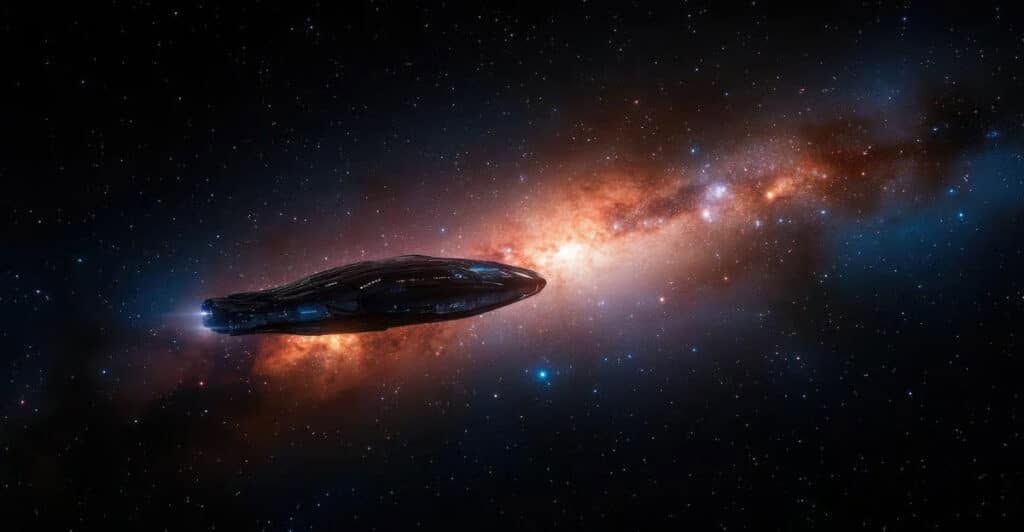
몇 달 동안 그래왔듯이, 뢰브는 혜성에 대한 정보를 제공하는 포털인 Medium에 모든 새로운 소식을 게시했습니다. 이번에 과학자는 3I/ATLAS가 기술적 목적을 가진 모선일 수 있다고 다시 제안했습니다.
뢰브는 그의 기사에서 "가설적으로 성간 물체 3I/ATLAS가 목성에 기술 장치를 심기 위해 설계된 모선이라고 가정해 봅시다. 이 성간 정원사는 목성에서 얼마나 멀리 떨어져 있어야 할까요?"라고 말했습니다.
구체적으로, 이를 달성하기 위해 저자는 혜성이 목성의 중력이 태양의 중력보다 우세하고 안정적인 궤도를 허용하는 영역인 목성의 중력 영향 반경(힐 반경이라고 함)에 도달해야 한다고 제안합니다.
따라서 뢰브는 거리와 질량 데이터를 사용하여 이 반경이 2026년 3월 16일에 535억 200만 킬로미터이며, 이는 3I/ATLAS가 위치할 최소 거리와 거의 유사하다고 계산했습니다. 구체적으로 혜성은 534억 4500만 킬로미터 떨어진 곳에 위치할 것입니다.
여기서 3I/ATLAS가 태양에 가장 가까워졌을 때(근일점이라고 함) 기록한 비중력 가속이 작용할 가능성이 있습니다. 한 달도 채 안 되어 NASA의 제트 추진 연구소(JPL)의 항해 엔지니어인 다비데 파르노치아(Davide Farnoccia)는 3I/ATLAS가 태양의 중력에 영향을 받는 경우 따라야 할 궤도에서 "적경에서 4초 호를 벗어났다"고 관찰했습니다.
뢰브는 "만약 3I/ATLAS가 기술적으로 만들어진 것이라면, 목성의 힐 반경에 도달하기 위해 추진기의 도움으로 궤도를 조정했을 수 있습니다."라고 제안합니다.
더 큰 불확실성을 위해, 천체물리학자는 근일점이 물체가 태양 뒤에 숨겨져 지구에서 모니터링하기 어려운 시기와 일치했다고 설명하여 탐지되지 않은 기동이나 장치 방출의 가능성을 열었습니다.
마지막으로 뢰브의 기사는 이러한 우연의 일치에 대한 통계적 확률과 3I/ATLAS가 실제로 목성 궤도에 기술을 남기는 경우의 의미를 평가합니다. 실제로 전문가는 주노 탐사선 또는 다른 임무에 의한 미래의 탐지가 이 가설을 확인할 수 있다고 자세히 설명합니다.
"만약 우리가 보내지 않은 목성의 기술 위성을 발견한다면, 그것은 목성이 외계 문명에 관심이 있다는 것을 의미할 것입니다. 지구 근처에서 유사한 장치를 찾지 못한다면, 우리 성간 손님이 우리에게 관심이 없다는 것을 시사하기 때문에 실망스러울 수 있습니다. 우리는 태양계의 중심에 있을 뿐만 아니라, 우주 이웃의 관심의 중심에도 있지 않습니다. 이것은 우리의 자존심에 타격이 될 것입니다."라고 그는 결론지었습니다.
3I/ATLAS가 우리 행성에 더 가까워짐에 따라 혜성에 대한 더 자세한 정보를 알게 될 것입니다. 2025년 12월 19일에 3I/ATLAS가 지구에 가장 가까운 지점인 2억 7천만 킬로미터 거리에 도달할 것으로 예상되며, 이때 수백 개의 지상 망원경과 허블 및 웹 우주 망원경이 관찰할 수 있는 최적의 기회를 가질 것입니다.
The Latest Anomaly of 3I/ATLAS Sparks Uncertainty Again
"Suppose it's a mothership..."
Just days after the scientific community had seemingly found some calm thanks to the latest images and information shared by NASA, Avi Loeb has once again stirred up a new scenario surrounding the comet 3I/ATLAS. The peculiar Harvard astrophysicist, a staunch advocate for the existence of extraterrestrial life, pointed out a "new extraordinary anomaly" of the third interstellar object.
As has become customary over the months, Loeb has published every update on Medium, the portal he uses to report on the comet. This time, the scientist has once again suggested that 3I/ATLAS could be a mothership with technological purposes.
"Suppose, hypothetically, that the interstellar object 3I/ATLAS is a mothership designed to seed Jupiter with technological devices. What would be the furthest distance from Jupiter that this interstellar gardener should reach?" Loeb stated in his article.
Specifically, to achieve this, the author suggests that the comet should reach Jupiter's gravitational influence radius—known as the Hill radius—a region where Jupiter's gravity dominates over the Sun's and allows for stable orbits.
Therefore, using distance and mass data, Loeb calculated that this radius is 53.502 billion kilometers on March 16, 2026, a figure practically similar to the minimum distance at which 3I/ATLAS will be located. Specifically, the comet will be placed 53.445 billion kilometers away, a practically similar figure.
This is where the possible non-gravitational acceleration that 3I/ATLAS registered during its closest approach to the Sun—a phenomenon known as perihelion—comes into play. Less than a month ago, the navigation engineer at NASA's Jet Propulsion Laboratory (JPL), Davide Farnocchia, observed that 3I/ATLAS deviated "four arcseconds in right ascension" from the trajectory it should have followed if it were influenced by the Sun's gravity.
"If 3I/ATLAS is of technological origin, it could have adjusted its trajectory with the help of thrusters to reach Jupiter's Hill radius," Loeb suggests.
Adding to the uncertainty, the astrophysicist went on to explain that the perihelion coincided with a period when the object was hidden behind the Sun, making it difficult to monitor from Earth, which opens the possibility of undetected maneuvers or even a release of devices.
Finally, Loeb's article evaluates the statistical probability of this coincidence and the implications if 3I/ATLAS actually left technology in Jovian orbit. In fact, the expert details that the possible future detection by the Juno probe or other missions could confirm this hypothesis.
"If we find technological satellites of Jupiter that we have not sent, it would imply that Jupiter is of interest to an extraterrestrial civilization. Not finding similar devices near Earth could be disappointing, as it would suggest that our interstellar guest is not interested in us. Not only are we not at the center of the solar system, but we're also not the center of attention in our cosmic neighborhood. This would be a blow to our ego," he concludes.
Let's remember that we will know more details of the comet as it gets closer to our planet. It is planned that on December 19, 2025, 3I/ATLAS will reach its closest point to Earth, at a distance of 270 million kilometers, at which time hundreds of terrestrial telescopes, as well as the Hubble and Webb space telescopes, will have the best opportunity to observe it.