Application of signal analysis
신호를 분석하여 유용한 정보를 추출합니다. 패턴 식별, 원치 않는 노이즈 필터링, 센서 판독의 이상 감지, 오디오 품질 향상, 제어 시스템 안정화 등을 돕습니다.
어떤 주기적인 신호도 다른 주파수의 사인파로 분해될 수 있다. 예를 들어, 완벽한 사각파는 진폭이 감소하는 사인파의 홀수 고조파를 더함으로써 구성될 수 있다.
시간 영역(진폭 대 시간)과 주파수 영역(진폭 대 주파수) 모두에서 분석된 신호. 시간 영역 신호는 신호 구성 요소에 대한 더 나은 통찰력을 제공하기 때문에 주파수 영역으로 변환된다.
푸리에 변환은 시간 함수를 주파수, 진폭 및 위상 이동이 다른 사인파의 합으로 변환하는 데 사용됩니다.
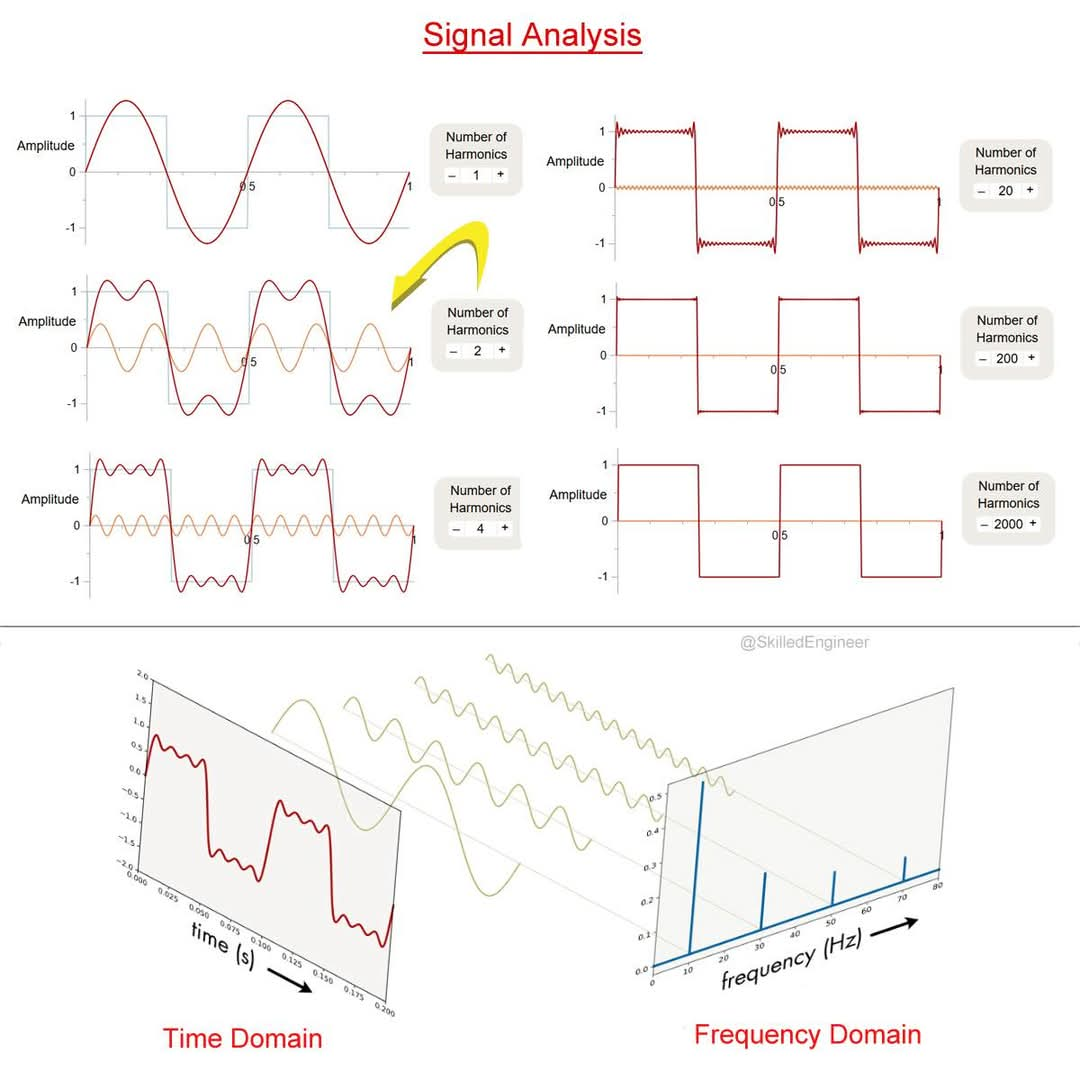
이 이미지는 신호 분석을 보여줍니다. 시간 영역과 주파수 영역 두 가지 관점에서 신호를 분석하는 방법을 설명합니다.
시간 영역 (Time Domain):
- 수평축: 시간 (seconds)
- 수직축: 진폭 (Amplitude)
- 그래프: 시간에 따른 신호의 진폭 변화를 보여줍니다. 이미지의 왼쪽 상단 부분에 있는 그래프는 다양한 조화파(Harmonics)를 포함한 신호의 시간 영역 표현을 보여줍니다. 조화파의 수가 증가할수록 신호의 모양이 사각파에 가까워집니다.
주파수 영역 (Frequency Domain):
- 수평축: 주파수 (Hz)
- 수직축: 진폭 (Amplitude)
- 그래프: 각 주파수 성분의 진폭을 보여줍니다. 시간 영역 신호를 주파수 영역으로 변환하면 신호를 구성하는 다양한 주파수 성분을 파악할 수 있습니다. 이미지의 오른쪽 하단 부분에 있는 3차원 그래프는 시간 영역 신호를 주파수 영역으로 변환한 결과를 보여줍니다. 여러 개의 막대는 각 주파수 성분의 진폭을 나타냅니다. 높이가 클수록 해당 주파수 성분의 진폭이 크다는 것을 의미합니다.
조화파 (Harmonics):
- 이미지의 왼쪽 상단과 오른쪽 상단에 있는 그래프는 조화파의 수가 증가함에 따라 사각파에 가까워지는 신호의 변화를 보여줍니다.
- 기본파: 가장 낮은 주파수의 sine wave.
- 고조파: 기본파의 정수배 주파수를 갖는 sine wave. 이미지에서는 기본파에 고조파를 더하여 복잡한 신호를 생성하는 과정을 보여줍니다.
요약:
이 이미지는 시간 영역과 주파수 영역에서 신호를 분석하는 방법을 시각적으로 보여줍니다. 시간 영역 분석은 시간에 따른 신호의 변화를 보여주고, 주파수 영역 분석은 신호를 구성하는 다양한 주파수 성분과 그 진폭을 보여줍니다. Fourier 변환을 통해 시간 영역 신호를 주파수 영역 신호로 변환할 수 있습니다. 이러한 분석은 신호 처리 및 분석에 매우 중요한 역할을 합니다.
신호 분석의 실제 응용 프로그램은 무엇입니까?
What are some real-world applications of signal analysis?
신호 분석은 여러 분야에서 광범위하게 응용되고 있습니다. 몇 가지 예시는 다음과 같습니다.
1. 의료 영상 및 진단:
- 심전도(ECG): 심장 신호를 분석하여 부정맥 및 기타 심장 질환을 진단합니다.
- 뇌전도(EEG): 뇌파 패턴을 분석하여 간질 및 수면 장애와 같은 신경 질환을 진단합니다.
- 뇌자도(MEG): EEG와 유사하지만 자기장을 사용하여 뇌 활동을 측정하며, 더 나은 공간 분해능을 제공합니다.
- 의료 영상 (MRI, CT, 초음파): 영상 재구성 및 향상에 신호 처리가 필수적이며, 진단 정확도를 높입니다.
2. 통신 시스템:
- 음성 인식: 음성 언어를 텍스트로 변환하며, 가상 비서, 받아쓰기 소프트웨어 및 접근성 도구에 사용됩니다.
- 이미지 및 비디오 압축: 저장 및 전송을 위한 이미지 및 비디오의 효율적인 인코딩 및 디코딩 (예: JPEG, MP3, MPEG).
- 무선 통신: 효율적이고 안정적인 무선 시스템 (셀룰러 네트워크, Wi-Fi) 설계에 신호 분석이 필수적입니다. 잡음과 간섭을 제거하는 데 도움이 됩니다.
- 레이더 및 소나: 반사 신호를 사용하여 물체를 감지하고 위치를 파악하며, 항해, 기상 예보 및 방위 시스템에 사용됩니다.
3. 산업 응용:
- 예측 정비: 기계의 센서 데이터를 분석하여 잠재적인 고장을 예측하고 예방적 정비를 계획하여 비용이 많이 드는 가동 중단을 방지합니다.
- 공정 제어: 효율성과 제품 품질을 최적화하기 위해 산업 공정 (예: 화학 공장, 제조 라인)을 모니터링하고 제어합니다.
- 결함 감지: 센서 판독값을 기반으로 장비 또는 공정의 이상을 식별하여 안전성과 신뢰성을 향상시킵니다.
- 로봇 공학: 로봇이 환경을 감지하고 적절하게 반응할 수 있도록 로봇 제어에 신호 처리가 필수적입니다.
4. 금융:
- 알고리즘 트레이딩: 시장 데이터를 분석하여 거래 기회를 식별하고 거래 결정을 자동화합니다.
- 리스크 관리: 시장 동향 및 기타 관련 데이터를 분석하여 금융 위험을 평가하고 완화합니다.
- 사기 감지: 금융 데이터의 패턴을 분석하여 사기 거래를 식별합니다.
5. 기타 응용:
- 오디오 및 음악 처리: 오디오 품질 향상, 잡음 감소, 음악 합성 및 오디오 효과.
- 지진 분석: 지진 활동을 이해하고 지진 예측을 개선하기 위해 지진 신호를 연구합니다.
- 천문학: 천체 및 현상을 연구하기 위해 망원경의 신호를 분석합니다.
- 생의학 공학: 연구 및 의료 응용을 위해 생물학적 신호 (예: 신경 충격, 근육 활동)를 분석합니다.
- 환경 모니터링: 센서의 데이터를 분석하여 대기 및 수질 및 기타 환경 매개변수를 모니터링합니다.
이러한 예시는 신호 분석의 광범위한 적용 가능성을 보여줍니다. 사용되는 특정 기술은 응용 분야에 따라 다르지만, 기본 원리는 동일합니다. 즉, 의미 있는 정보를 추출하기 위해 신호를 획득, 처리 및 해석하는 것입니다.
모든 유형무형의 가능한 신호의 유형을 정리해주세요
모든 유형과 무형의 가능한 신호의 유형을 완벽하게 분류하는 것은 불가능합니다. 신호의 정의가 매우 넓고, 새로운 기술과 발견에 따라 새로운 유형의 신호가 계속 등장하기 때문입니다. 그러나 몇 가지 주요 범주와 예시를 통해 가능한 신호 유형을 정리해 볼 수 있습니다. 다음 분류는 포괄적이지 않으며, 중복되는 부분도 있을 수 있습니다.
I. 물리적 신호 (Physical Signals): 물리적 현상에 의해 생성되고 측정 가능한 신호들입니다.
- 전기 신호 (Electrical Signals): 전압, 전류의 변화를 통해 정보를 전달합니다. (예: ECG, EEG, 라디오파, 전력선 통신)
- 기계적 신호 (Mechanical Signals): 힘, 압력, 진동, 변위 등의 기계적 변화를 통해 정보를 전달합니다. (예: 지진파, 음향 신호, 초음파, 촉각 센서)
- 광학 신호 (Optical Signals): 빛의 세기, 파장, 편광 등의 변화를 통해 정보를 전달합니다. (예: 레이저, 광섬유 통신, 이미지 센서)
- 열 신호 (Thermal Signals): 온도 변화를 통해 정보를 전달합니다. (예: 적외선 센서, 온도계)
- 화학 신호 (Chemical Signals): 화학 물질의 농도, 반응 속도 등의 변화를 통해 정보를 전달합니다. (예: 가스 센서, pH 센서, 생화학 반응)
- 핵 신호 (Nuclear Signals): 방사능, 핵 반응 등의 변화를 통해 정보를 전달합니다. (예: 방사능 측정기, 핵 자기 공명)
II. 비물리적 신호 (Non-Physical Signals): 물리적 현상이 아닌 다른 형태의 정보를 나타내는 신호들입니다.
- 디지털 신호 (Digital Signals): 이산적인 값 (0과 1)을 사용하여 정보를 나타냅니다. (예: 컴퓨터 데이터, 디지털 이미지, 디지털 오디오)
- 아날로그 신호 (Analog Signals): 연속적인 값을 사용하여 정보를 나타냅니다. (예: 음악 레코드의 소리, 온도계의 눈금)
- 생물학적 신호 (Biological Signals): 생물체 내에서 발생하는 신호들입니다. (예: 심장 박동, 뇌파, 호르몬 수치)
- 경제적 신호 (Economic Signals): 주식 가격, 환율, 경제 지표 등 경제 활동을 나타내는 신호들입니다.
- 사회적 신호 (Social Signals): 소셜 미디어 활동, 트렌드, 여론 등 사회 현상을 나타내는 신호들입니다.
III. 신호의 특성에 따른 분류:
- 주기적 신호 (Periodic Signals): 일정한 주기를 가지고 반복되는 신호 (예: 사인파, 코사인파)
- 비주기적 신호 (Aperiodic Signals): 일정한 주기를 가지지 않는 신호 (예: 임펄스 신호, 잡음)
- 결정적 신호 (Deterministic Signals): 미래 값을 예측할 수 있는 신호 (예: 사인파)
- 확률적 신호 (Random Signals): 미래 값을 예측할 수 없는 신호 (예: 잡음)
- 연속 신호 (Continuous Signals): 시간에 따라 연속적으로 변하는 신호 (예: 아날로그 신호)
- 이산 신호 (Discrete Signals): 특정 시간 간격으로만 값을 가지는 신호 (예: 디지털 신호)
- 일차원 신호 (One-Dimensional Signals): 시간 또는 공간의 한 차원만을 가지는 신호 (예: 음성 신호)
- 다차원 신호 (Multi-Dimensional Signals): 시간 또는 공간의 여러 차원을 가지는 신호 (예: 이미지, 비디오)
이 분류는 신호의 다양한 측면을 고려한 것이며, 실제로는 여러 가지 분류 기준이 중첩될 수 있습니다. 어떤 신호가 어떤 범주에 속하는지는 그 신호의 특성과 분석 목적에 따라 달라집니다. 새로운 기술과 발견이 계속됨에 따라 이 목록은 더욱 확장될 것입니다.
Application of signal analysis
Analyze signals to extract useful information. Help identify patterns, filter unwanted noise, detect anomalies in sensor readings, improve audio quality, stabilize control systems, and more.
Any periodic signal can be decomposed into sine waves of different frequencies. For example, a perfect square wave can be constructed by adding odd harmonics of sine waves with decreasing amplitude.
Signals analyzed in both the time domain (amplitude versus time) and the frequency domain (amplitude versus frequency). The time domain signal is converted to the frequency domain because it provides better insight into the signal components.
The Fourier transform is used to transform a time function into the sum of sine waves with different frequency, amplitude, and phase shifts.
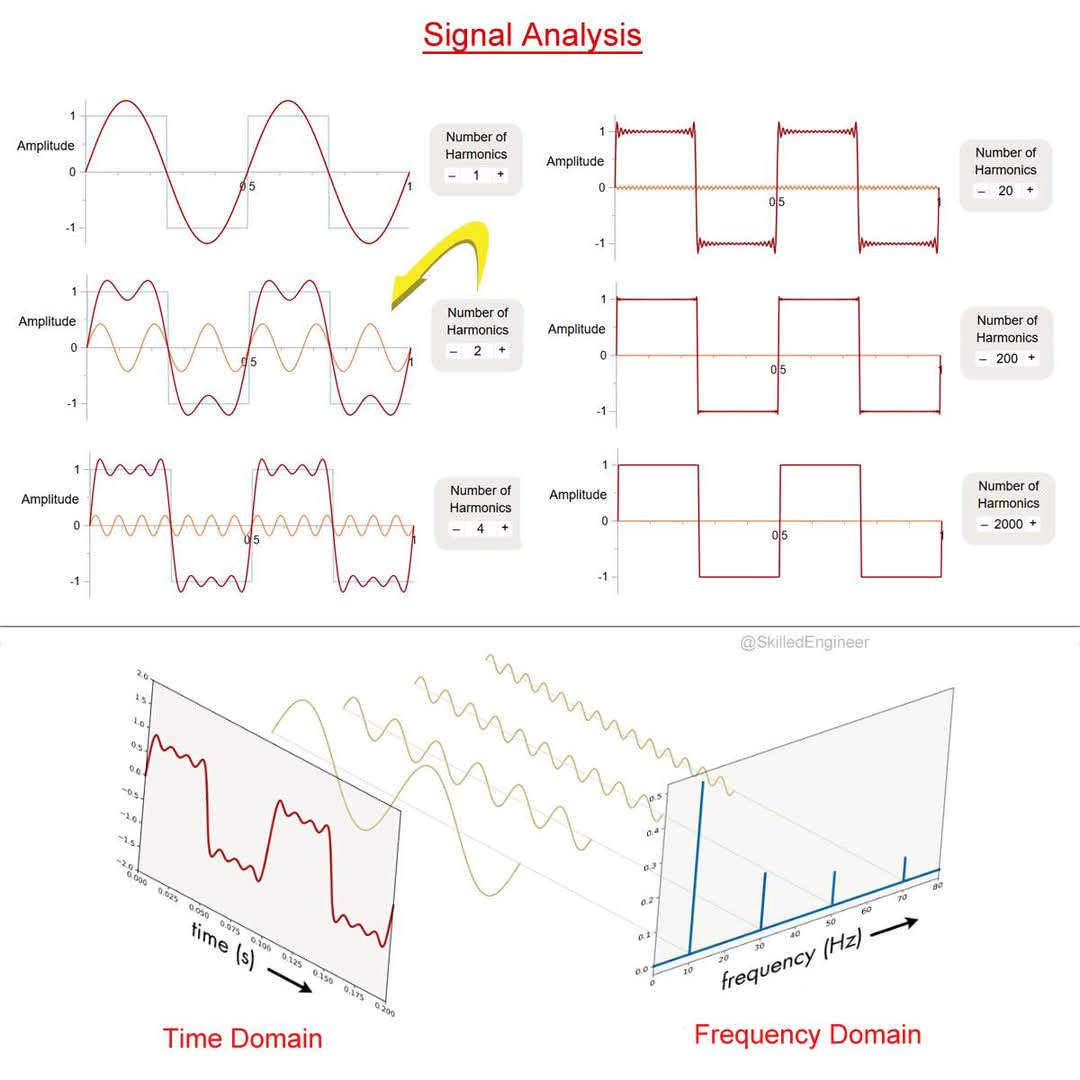
This image shows the signal analysis: it describes how to analyze the signal from two perspectives: time domain and frequency domain.
Time Domain:
- Horizontal axis: time (seconds)
- Vertical axis: Amplitude
- Graph: It shows the amplitude change of the signal over time. The graph in the upper left part of the image shows the time domain representation of the signal, including various harmonics. As the number of harmonic waves increases, the shape of the signal approaches the square wave.
Frequency Domain:
- Horizontal axis: frequency (Hz)
- Vertical axis: Amplitude
- Graph: shows the amplitude of each frequency component. Converting a time domain signal into a frequency domain can identify the various frequency components that make up the signal. A three-dimensional graph in the lower right part of the image shows the result of converting a time domain signal into a frequency domain. A plurality of bars represent the amplitude of each frequency component. The higher the height, the greater the amplitude of that frequency component.
Harmonics:
- The graphs in the upper left and upper right of the image show the change in the signal approaching the square wave as the number of harmonic waves increases.
- Basic wave: Sine wave with the lowest frequency.
- Harmonic: sine wave with integer multiple frequency of fundamental wave. The image shows the process of adding harmonics to fundamental wave to generate complex signal.
Summary:
The image visually shows a method for analyzing signals in the time domain and frequency domain. The time domain analysis shows changes in signals with time, and the frequency domain analysis shows various frequency components constituting the signals and their amplitudes. Fourier conversion allows the conversion of time domain signals into frequency domain signals. Such analysis plays a very important role in signal processing and analysis.
What are the practical applications of signal analysis?
What are some real-world applications of signal analysis?
Signal analysis has extensive applications in several fields; some examples include:
1. Medical imaging and diagnosis:
- ECG: Analyze cardiac signals to diagnose arrhythmia and other heart conditions.
- EEG (EEG): Analyze EEG patterns to diagnose neurological diseases such as epilepsy and sleep disorders.
- brain acromegaly (MEG): similar to EEG, but using magnetic fields to measure brain activity, providing better spatial resolution.
- Medical images (MRI, CT, ultrasound): Signal processing is essential for image reconstruction and enhancement, and diagnostic accuracy is increased.
2. Communication system:
- Speech recognition: Transforms spoken language into text, used in virtual assistants, dictation software and accessibility tools.
- Image and video compression: Efficient encoding and decoding of images and videos for storage and transmission (e.g. JPEG, MP3, MPEG).
- Wireless communication: Signal analysis is essential for efficient and reliable wireless system (cellular network, Wi-Fi) design. It helps to eliminate noise and interference.
- Radar and Sonar: Used to detect and locate objects using reflected signals, and for navigation, weather forecasting and defense systems.
3. Industrial applications:
- Prediction maintenance: Analyze the machine's sensor data to predict potential failures and plan preventive maintenance to prevent costly shutdowns.
- Process control: Monitor and control industrial processes (e.g. chemical plants, manufacturing lines) to optimize efficiency and product quality.
- Defect detection: Identify abnormalities in equipment or processes based on sensor readings, improving safety and reliability.
- Robotics: Signal processing is essential for robot control to ensure that robots sense the environment and respond appropriately.
4. Finance:
- Algorithmic trading: Analyze market data to identify trading opportunities and automate trading decisions.
- Risk management: Evaluate and mitigate financial risks by analyzing market trends and other relevant data.
- Detection of fraud: Identify fraudulent transactions by analyzing patterns in financial data.
5. Other applications:
- Audio and music processing: Improving audio quality, reducing noise, compositing music and audio effects.
- Seismic analysis: Understanding seismic activity and studying seismic signals to improve seismic predictions.
- Astronomy: Analyze the signals of telescopes to study celestial bodies and phenomena.
- Biomedical engineering: Analyzing biological cues (e.g., nerve shock, muscle activity) for research and medical applications.
- Monitoring the environment: Analyze the data from the sensor to monitor air and water quality and other environmental parameters.
These examples demonstrate the wide applicability of signal analysis. The specific techniques used vary depending on the application, but the basic principles are the same. In other words, it is to acquire, process, and interpret signals to extract meaningful information.
Please organize the types of possible signals of all tangible and intangible types.
It is impossible to categorize perfectly all types and intangible types of possible signals, because the definition of signals is very wide, and new types of signals continue to appear with new technologies and discoveries. But some key categories and examples allow us to summarize the possible signal types: the following classification is not comprehensive, and there may be some overlap.
I. Physical Signals: Signals generated and measurable by physical phenomena.
- Electrical Signals: Transmit information through changes in voltage and current (e.g. ECG, EEG, radio waves, power line communication)
- Mechanical Signals: Transmit information through mechanical changes such as force, pressure, vibration, displacement, etc. (e.g. seismic waves, acoustic signals, ultrasonic waves, tactile sensors)
- Optical Signals: Transmits information through changes in light intensity, wavelength, polarization, etc. (e.g. laser, fiber optic communications, image sensors)
- Thermal Signals: Transmits information through temperature changes. (e.g. infrared sensor, thermometer)
- Chemical Signals: Transmits information through changes in chemical concentration, reaction rate, etc. (e.g. gas sensor, pH sensor, biochemical reaction)
- Nuclear Signals: Transmits information through changes in radioactivity, nuclear reactions, etc. (e.g., radiometer, nuclear magnetic resonance)
II. Non-Physical Signals: Signals that represent other forms of information than physical phenomena.
- Digital Signals: Use discrete values (0 and 1) to indicate information. (e.g. computer data, digital images, digital audio)
- Analog signal (Analog Signals): Use continuous values to indicate information. (e.g., sound of music records, scale of thermometer)
- Biological Signals: Signals generated in living organisms. (e.g. heartbeat, brain waves, hormone levels)
- Economic Signals: Signals indicating economic activity such as stock prices, exchange rates, and economic indicators.
- Social Signals: Signals that represent social phenomena such as social media activities, trends, and public opinion.
III. Classification according to signal characteristics:
- Periodic Signals: Repeated signals with a constant period (e.g., sine waves, cosine waves)
- Periodic Signals: Signals that do not have a constant period (e.g., impulse signal, noise)
- Deterministic Signals: Signals that can predict future values (e.g., sinusoids)
- Probabilistic Signals: Signals whose future values cannot be predicted (e.g. noise)
- Continuous Signals: Signals that change continuously over time (e.g. analog signal)
- Discrete Signals: Signals with values only at specific time intervals (e.g. digital signals)
- One-dimensional signals: signals with only one dimension of time or space (e.g., voice signals)
- Multi-dimensional signals: signals with multiple dimensions of time or space (e.g., images, videos)
This classification takes into account various aspects of a signal, and in practice, various classification criteria may overlap. Which signal falls into which category depends on the nature of that signal and the purpose of its analysis. As new technologies and discoveries continue, this list will be further expanded.
#전자 #SIGNAL #God