Official table for logarithms
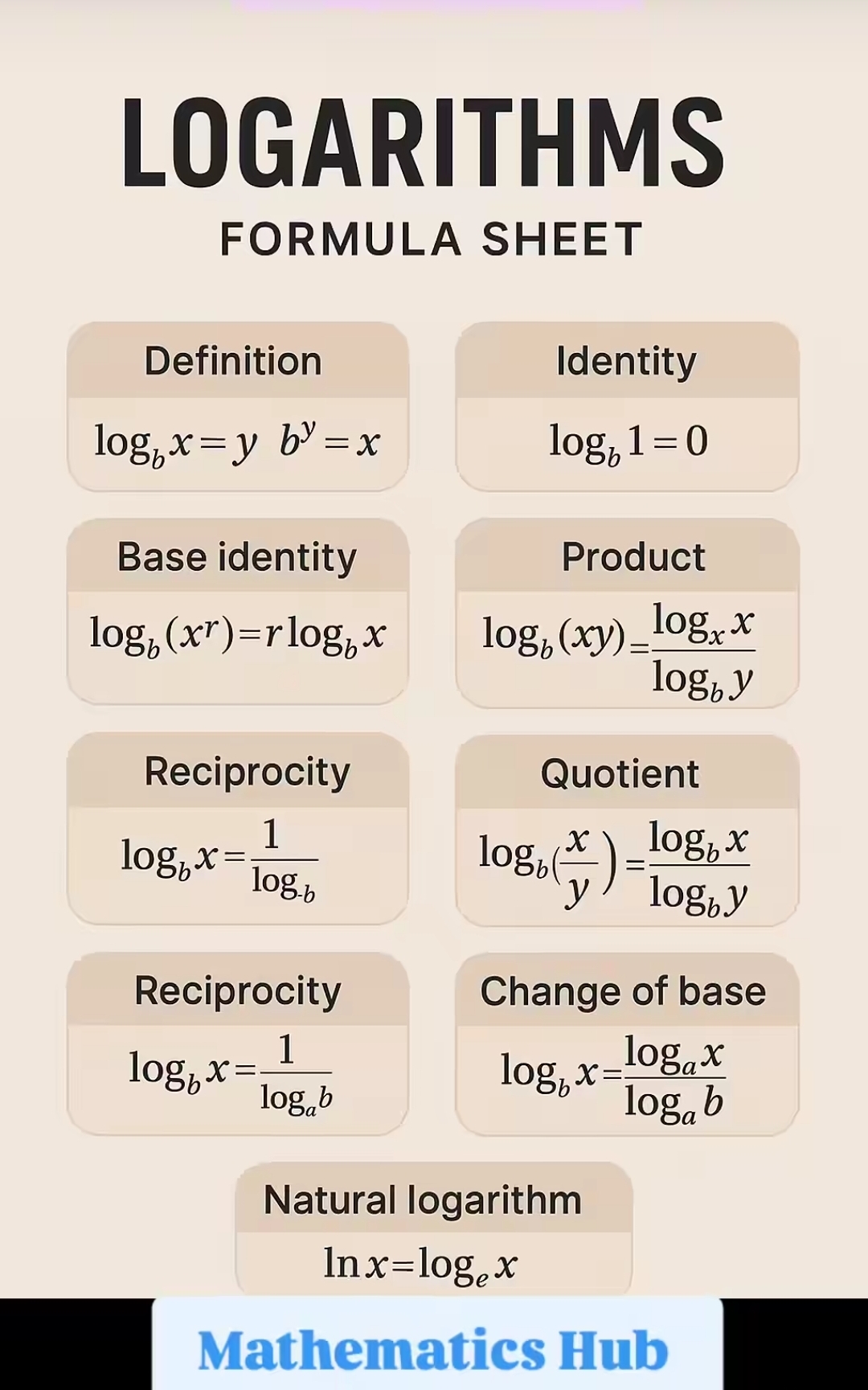
이 이미지는 로그에 대한 공식표를 제공합니다. 이미지에 나와있는 공식을 요약하면 다음과 같습니다.
1. 정의:
- logbx = y 는 by = x 와 같습니다. 이것은 로그의 기본 정의입니다. b를 y승 하면 x가 된다는 것을 의미합니다.
2. 항등원:
- logb1 = 0 입니다. 0을 제외한 모든 밑(base)에 대해 1의 로그 값은 항상 0입니다. 어떤 수를 0승 하면 1이 되기 때문입니다.
3. 밑의 항등식:
- logb(xr) = r logbx 입니다. 이 법칙을 이용하면 지수를 로그 밖으로 꺼내어 곱으로 나타낼 수 있습니다.
4. 곱셈 법칙:
- logb(xy) = logbx + logby 입니다. 곱의 로그는 각 인수의 로그의 합과 같습니다.
5. 나눗셈 법칙:
- logb(x/y) = logbx - logby 입니다. 몫의 로그는 분자의 로그에서 분모의 로그를 뺀 값과 같습니다.
6. 역수 법칙 (두 가지 버전):
- logbx = 1 / logxb
- logbx = 1 / logab (이 버전은 밑 변환을 보여줍니다)
7. 밑 변환 법칙:
- logbx = logax / logab 입니다. 이 법칙을 이용하여 로그의 밑을 b에서 a로 변경할 수 있습니다.
8. 자연로그:
- ln x = logex 입니다. 자연로그(ln)는 수학 상수 e (약 2.718)를 밑으로 사용합니다.
이 공식표는 로그 식과 방정식을 다룰 때 유용한 참고 자료입니다. 밑 b는 항상 양수여야 하며 1이 아니어야 함을 기억하십시오.
This image provides a formula table for the log. A summary of the formula shown in the image is as follows:
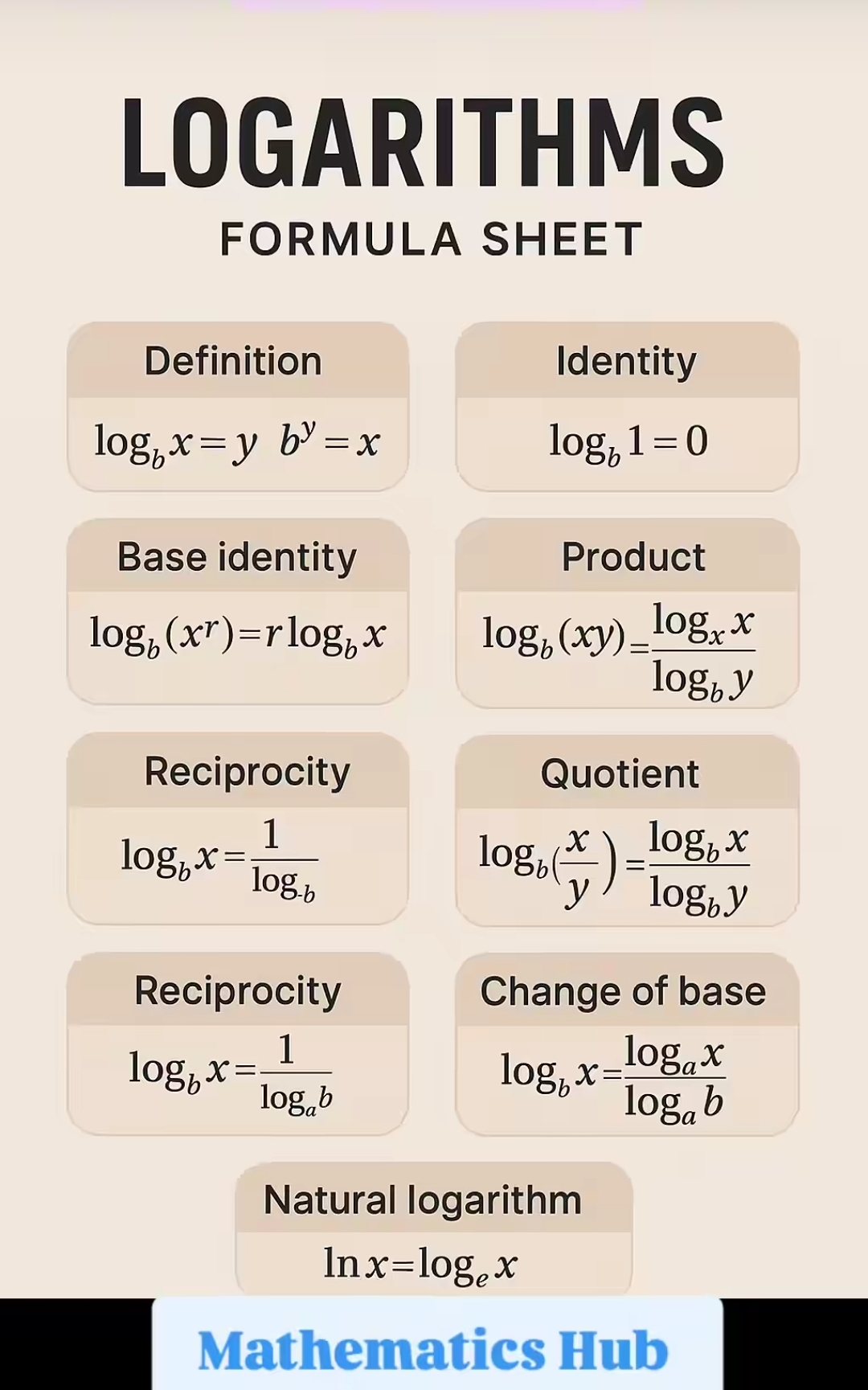
This image provides a formula sheet for logarithms. Here's a summary of the formulas shown:
1. Definition:
- logbx = y is equivalent to by = x. This is the fundamental definition of a logarithm. It states that the logarithm of x to the base b is the exponent y to which b must be raised to obtain x.
2. Identity:
- logb1 = 0. The logarithm of 1 to any base (except 0) is always 0. This is because any number raised to the power of 0 equals 1.
3. Base Identity:
- logb(xr) = r logbx. This rule allows you to move an exponent outside the logarithm as a multiplier.
4. Product Rule:
- logb(xy) = logbx + logby. The logarithm of a product is the sum of the logarithms of the individual factors.
5. Quotient Rule:
- logb(x/y) = logbx - logby. The logarithm of a quotient is the difference between the logarithms of the numerator and the denominator.
6. Reciprocity Rule (two versions):
- logbx = 1 / logxb
- logbx = 1 / logab (This version shows a change of base)
7. Change of Base Rule:
- logbx = logax / logab. This rule allows you to change the base of a logarithm from b to a.
8. Natural Logarithm:
- ln x = logex. The natural logarithm (ln) uses the mathematical constant e (approximately 2.718) as its base.
This formula sheet is a handy reference for working with logarithmic expressions and equations. Remember that the base b must always be positive and not equal to 1.