Simulated reality (26-2)
현실을 착각하여 이러한 투영을 진짜 대상 자체로 여기는 것이 매개되고 잠재적으로 환상적인 경험의 기본적인 주제를 확립합니다. 수세기 후, 르네 데카르트는 그의 제1철학에 관한 명상에서 그의 "악마"로 이 회의론을 급진화시켰습니다. 강력하고 악의적인 존재가 감각 입력을 조작하여 꿈과 현실을 구분하는 것을 불가능하게 만드는 사고 실험을 통해 데카르트는 모든 감각 입력의 존재를 주장했습니다. 플라톤의 동굴과 데카르트의 악마는 모두 핵심적인 문제를 제기합니다. 즉, 우리의 인식과 현실의 궁극적인 본질 사이의 잠재적인 분리, 외부 힘이나 구조에 의해 조정되는 분리입니다.
이 아이디어의 현대적인 공식화인 닉 보스트롬의 시뮬레이션 논증은 확률과 계산 이론의 언어로 이 철학적 회의론을 재구성합니다. 보스트롬의 주장은 우리가 시뮬레이션 속에서 살고 있다는 직접적인 주장이 아니라, 다음 세 가지 명제 중 적어도 하나가 참이어야 한다는 논리적 삼단논법입니다. (1) 인간 수준의 문명 중 고충실도 조상 시뮬레이션을 실행할 수 있는 "포스트휴먼" 단계(하나)에 도달하는 비율은 0에 매우 가깝습니다. (2) 포스트휴먼 문명 중 조상 시뮬레이션에 관심 있는 비율은 0에 매우 가깝습니다. (3) 우리와 같은 경험을 하는 사람들 중 시뮬레이션 속에서 살고 있는 비율은 1에 매우 가깝습니다.⁵
이 주장의 논리는 두 가지 핵심 가정에 달려 있습니다. 첫 번째는 마음의 철학에서 나온 기질 독립성이라는 개념으로, 의식은 탄소 기반 생물학과 같은 특정 물리적 매체에 본질적으로 묶여 있지 않다는 것입니다. 대신 정신 상태는 어떤 물리적 시스템에서도 실현될 수 있으며, 올바른 계산 구조와 과정을 구현한다면 원칙적으로 실리콘 칩과 같은 다른 기질에서 복제될 수 있습니다.⁵ 두 번째 가정은 기술적으로 성숙한 "포스트휴먼" 문명은 그러한 "조상 시뮬레이션"을 대량으로 실행할 수 있는 충분한 계산 능력을 갖게 될 것이라는 것입니다.¹⁰ 만약 명제 (1)과 (2)가 거짓이라면—즉, 문명은 생존하고 시뮬레이션을 실행하는 경향이 있다는 것을 의미합니다—그러면 시뮬레이션된 의식 존재의 수는 "원래" 생물학적 존재의 수를 압도할 것입니다. 무차별의 원리를 적용하면, 우리가 특별하다고 가정해서는 안 된다는 것을 명시하는데, 그렇다면 어떤 주어진 의식 관찰자(우리 자신과 같은)가 생물학적 소수가 아닌 시뮬레이션된 다수 중 하나일 가능성이 통계적으로 높아집니다.⁶
참고: 윗글에는 슈퍼스크립트(상첨자) 숫자가 여러 개 있습니다. 이 숫자들은 본문에 없는 참고문헌이나 각주를 가리키는 것으로 보입니다. 전체적인 의미를 이해하는 데는 지장이 없지만, 보다 정확한 이해를 위해서는 원문의 각주를 참고해야 합니다.
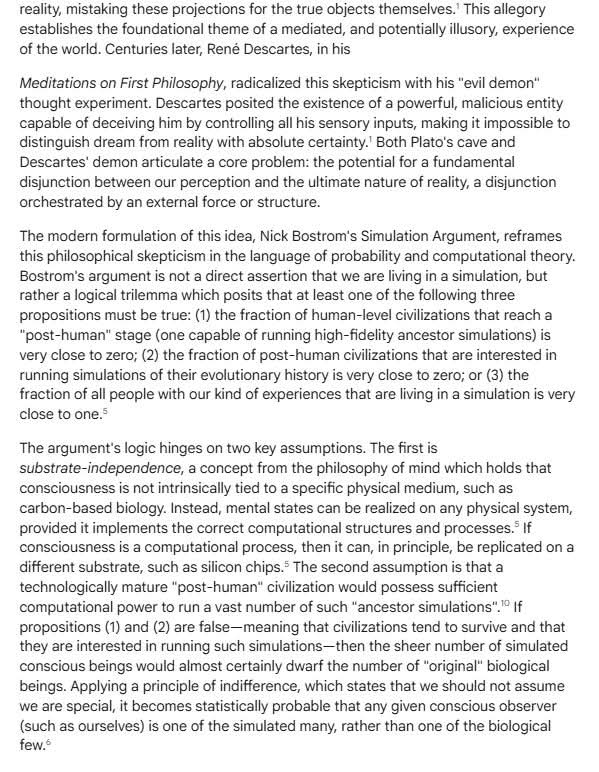
The English text of the image is translated directly into Korean as follows.
By mistaking reality, this conception of projection as the real object itself establishes the underlying theme of mediated and potentially fantastic experiences. Centuries later, René Descartes radicalized this skepticism with his "Devil" in his Meditations on First Philosophy. Through thought experiments, where powerful and malicious beings manipulate sensory inputs to make it impossible to distinguish between dreams and reality, Descartes asserted the existence of all sensory inputs. Both Plato's Cave and Descartes' Devil pose key issues. In other words, the potential separation between our perceptions and the ultimate nature of reality, the separation coordinated by external forces or structures.
A modern formulation of this idea, Nick Bostrom's simulation argument, reconstructs this philosophical skepticism in the language of probability and computational theory. Bostrom's argument is not a direct argument that we live in a simulation, but rather a logical syllogism that requires that at least one of the following three propositions be true. (1) "Posthumans" capable of executing high-fidelity ancestry simulations among human-level civilizations. The rate of reaching step (one) is very close to zero. (2) The percentage of posthuman civilizations interested in ancestral simulation is very close to zero. (3) The percentage of people who have the same experience as us living in the simulation is very close to 1. 5
The logic of this argument rests on two key assumptions. The first is the concept of substrate independence, which comes from the philosophy of mind, that consciousness is not inherently bound to certain physical media, such as carbon-based biology. Instead, mental states can be realized in any physical system, and if they implement the correct computational structure and process, they can in principle replicate in other substrates, such as silicon chips. 5 The second assumption is technically mature "posthumans". that civilization will have sufficient computational power to run such "ancestral simulations" in large quantities. 10 If propositions (1) and (2) are false—that is, it means that civilization tends to survive and execute simulations—then the number of simulated conscious beings is "original". It will overwhelm the number of biological beings. Applying the principle of indiscrimination, it states that we should not assume that we are special, so it is statistically more likely that any given conscious observer (such as ourselves) is one of the simulated majority rather than the biological minority. 6
Note: The above article has several superscript (supercript) numbers. These numbers appear to refer to references or footnotes that are not in the text. There is no problem in understanding the overall meaning, but for a more accurate understanding, you should refer to the footnotes in the text.
Next
top
Editorial Bridge of Love and Compassion