Basic composition of matter (quarks in molecules)
물질의 기본 구성 요소를 분자에서 쿼크까지 보여주는 그림입니다.
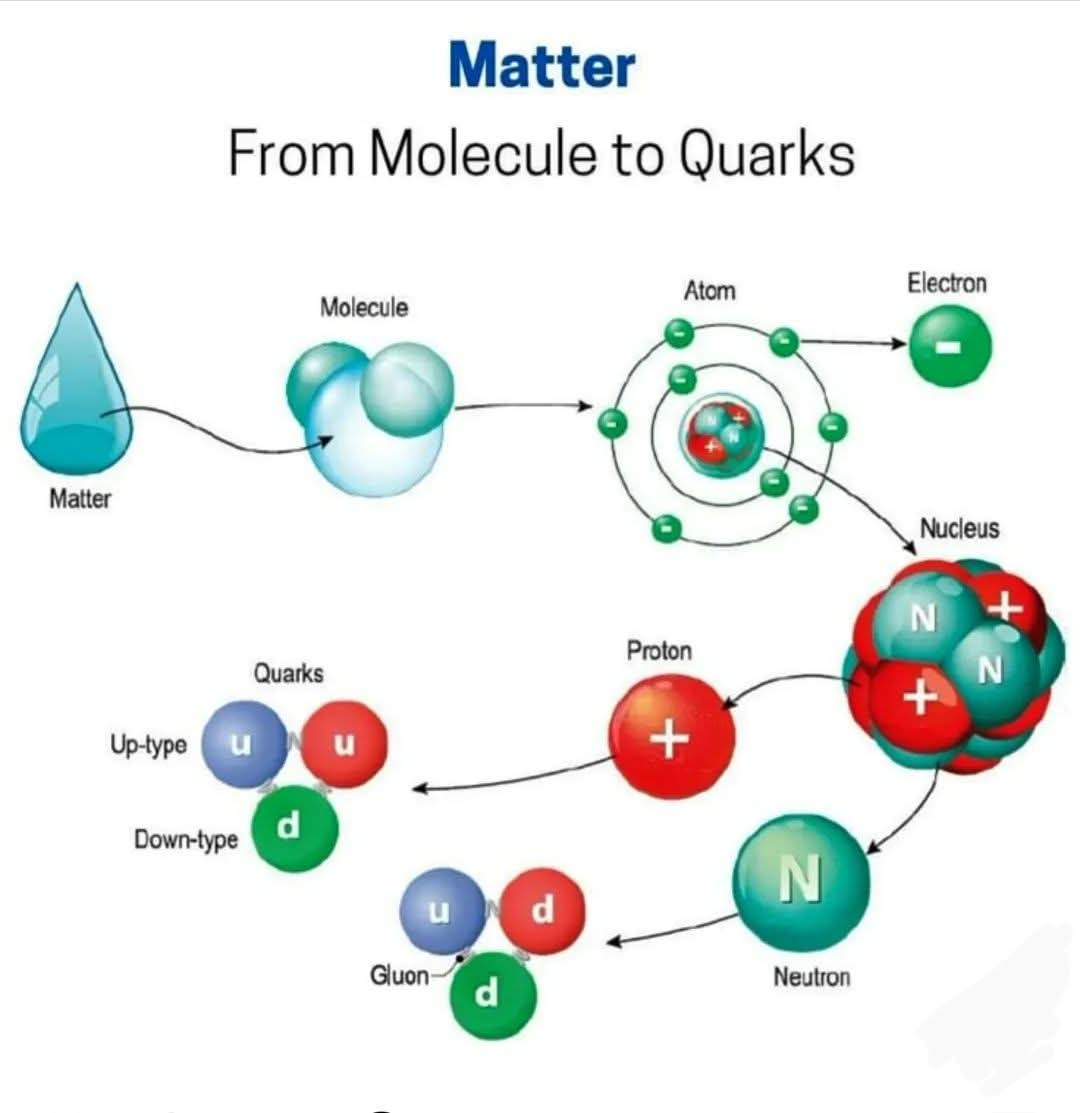
이미지의 주요 내용은 다음과 같습니다.
- 물질(Matter): 물방울 형태로 표현됨.
- 분자(Molecule): 여러 개의 원자가 결합한 형태.
- 원자(Atom): 중심에 핵(Nucleus)이 있고, 그 주위를 전자가 돌고 있는 형태.
- 전자(Electron): 원자핵 주위를 도는 음전하 입자.
- 핵(Nucleus): 양성자와 중성자로 구성됨.
- 양성자(Proton): 양전하를 띤 입자.
- 중성자(Neutron): 전하를 띠지 않은 입자.
- 쿼크(Quarks): 양성자와 중성자를 구성하는 더 작은 입자 (Up-type, Down-type).
- 글루온(Gluon): 쿼크 간의 강력을 매개하는 입자.
설명:
이미지는 물질이 분자에서 시작하여 원자, 핵, 그리고 궁극적으로 쿼크와 글루온과 같은 기본 입자로 구성된다는 것을 보여줍니다. 이는 물질의 계층적 구조를 설명하는 데 사용될 수 있습니다.
https://youtu.be/BtI_d-KAidQ?si=UjK-xBcMPtz3Esf9
The main contents of the image are as follows:
- Matter: It is expressed in the form of water droplets.
- Molecule: A form in which several atoms are bonded.
- Atom: A form in which a nucleus is located at the center and electrons are orbiting around it.
- Electron: Negative charged particles orbiting the nucleus.
- Nucleus: Consists of protons and neutrons.
- Proton: Positively charged particles.
- Neutron: Uncharged particles.
- Quarks: Smaller particles (Up-type, Down-type) that make up protons and neutrons.
- Gluon: Particles that mediate the force between quarks.
Description:
The image shows that matter starts with molecules and consists of atoms, nuclei, and ultimately elementary particles such as quarks and gluons. This can be used to describe the hierarchical structure of a material.