/* 이것이 무슨 뜻인지 몰라! 신의 기술이야. ELL LLN GOD! 하늘에서와 같이 땅에서도 이루어 지이다! */
Particulate system and rotational motion
입자계와 회전 운동, 쉽게 이해하는 핵심 요약!
입자계 (System of Particles): 여러 개의 점들이 모여 이루는 시스템
- 질량 중심 (Center of Mass): 여러 입자들의 "평균 위치"라고 생각하면 쉬워요. 마치 전체 시스템의 무게 중심처럼 행동합니다.
- 입자계 전체의 운동을 분석할 때, 질량 중심의 운동만 알면 편리하게 계산할 수 있어요.
- 운동량 (Momentum): "얼마나 움직이는 힘을 가지고 있나"를 나타내는 척도. 질량과 속도를 곱해서 구합니다.
- 외부 힘이 없으면 입자계 전체의 운동량은 항상 일정하게 유지됩니다 (운동량 보존 법칙!).
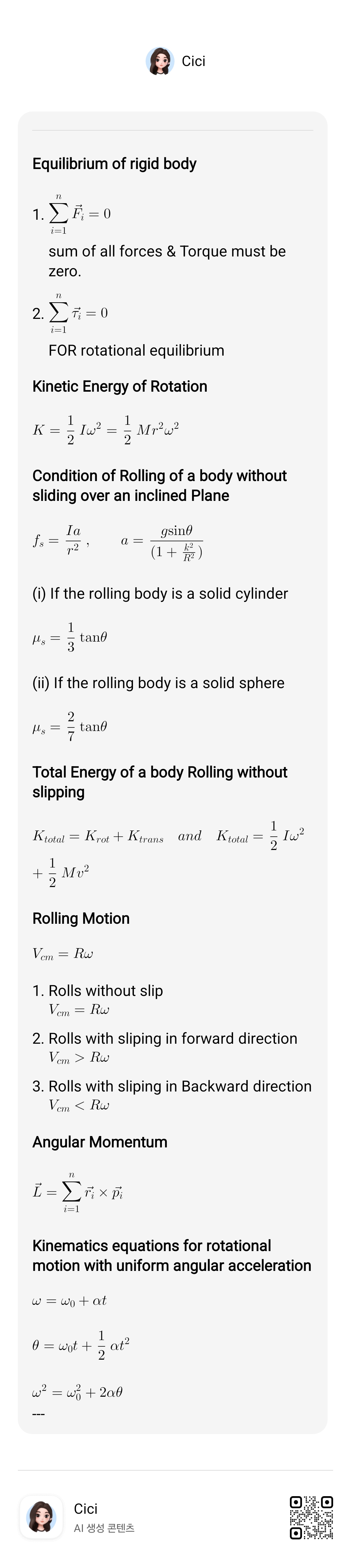
회전 운동 (Rotational Motion): 물체가 어떤 축을 중심으로 회전하는 운동
- 각속도 (Angular Velocity): "얼마나 빨리 회전하나"를 나타내는 척도.
- 돌림힘 (Torque): 물체를 회전시키는 "힘"이라고 생각하면 됩니다.
- 관성 모멘트 (Moment of Inertia): 회전 운동을 방해하는 정도를 나타내는 척도. 질량이 클수록, 회전축에서 멀리 떨어져 있을수록 관성 모멘트가 커집니다.
- 각운동량 (Angular Momentum): 회전 운동의 "운동량"이라고 생각하면 됩니다. 관성 모멘트와 각속도를 곱해서 구합니다.
- 외부 돌림힘이 없으면 각운동량은 항상 일정하게 유지됩니다 (각운동량 보존 법칙!).
구름 운동 (Rolling Motion): 회전하면서 동시에 이동하는 운동 (예: 바퀴, 공)
- 미끄러짐 없이 구르는 경우, 이동 속도와 회전 속도 사이에 특별한 관계가 있습니다.
- 에너지 보존 법칙을 이용하여 구름 운동을 분석할 수 있습니다.
핵심 연결 고리:
- 입자계의 운동은 질량 중심을 이용하여 간단하게 분석할 수 있습니다.
- 회전 운동은 각속도, 돌림힘, 관성 모멘트, 각운동량 등의 개념을 이용하여 분석합니다.
- 구름 운동은 회전 운동과 병진 운동이 결합된 형태입니다.
쉽게 생각하는 팁:
- 선형 운동 (직선 운동)과 회전 운동은 매우 유사한 개념과 법칙을 공유합니다. 선형 운동을 잘 이해하고 있다면, 회전 운동도 쉽게 이해할 수 있습니다.
- 각 운동량 보존 법칙은 피겨 스케이팅 선수가 팔을 오므릴 때 회전 속도가 빨라지는 현상을 설명하는 데 사용됩니다.
이 요약 설명이 입자계와 회전 운동에 대한 이해를 돕는 데 도움이 되기를 바랍니다!
영문 :
Particulate system and rotational motion
Particle systems and rotational motion, a key summary that is easily understood!
System of Particles: A system formed by gathering multiple dots.
- Center of Mass: It's easy to think of it as the "average position" of multiple particles. It behaves like the center of gravity of the entire system.
- When analyzing the motion of the entire particle system, it can be conveniently calculated by simply knowing the motion of the center of mass.
- Momentum: A measure of "how much moving force it has." It is obtained by multiplying the mass by the velocity.
- Without external forces, the momentum of the entire particle system remains constant at all times (the law of conservation of momentum! ).
Rotational Motion: A motion in which an object rotates about an axis.
- Angular Velocity: A measure of "how fast it rotates".
- Turning force (Torque): You can think of it as a "force" that rotates an object.
- Moment of Inertia: A measure of the degree to which it interferes with rotational motion. The greater the mass, the greater the moment of inertia, the farther away from the axis of rotation.
- Angular Momentum: You can think of it as the "momentum" of rotational motion. It is obtained by multiplying the moment of inertia by the angular velocity.
- Without external turning force, angular momentum always remains constant (the law of conservation of angular momentum! ).
Rolling Motion: A motion that moves simultaneously while rotating (e.g., wheels, balls)
- If you roll without slipping, there is a special relationship between the speed of movement and the speed of rotation.
- Cloud motion can be analyzed using the law of conservation of energy.
Key link:
- The motion of the particle system can be analyzed simply using the center of mass.
- Rotational motion is analyzed using concepts such as angular velocity, turning force, moment of inertia, and angular momentum.
- Cloud motion is a combination of rotational and translational motion.
Easy tips:
- Linear motion (straight motion) and rotational motion share very similar concepts and laws. If you understand linear motion well, rotational motion can also be easily understood.
- The law of conservation of angular momentum is used to describe the phenomenon where a figure skater speeds up rotation when their arms are closed.
Hopefully, this summary explanation will help us understand the particle system and rotational motion!