LIGO의 중력파 포착 과정
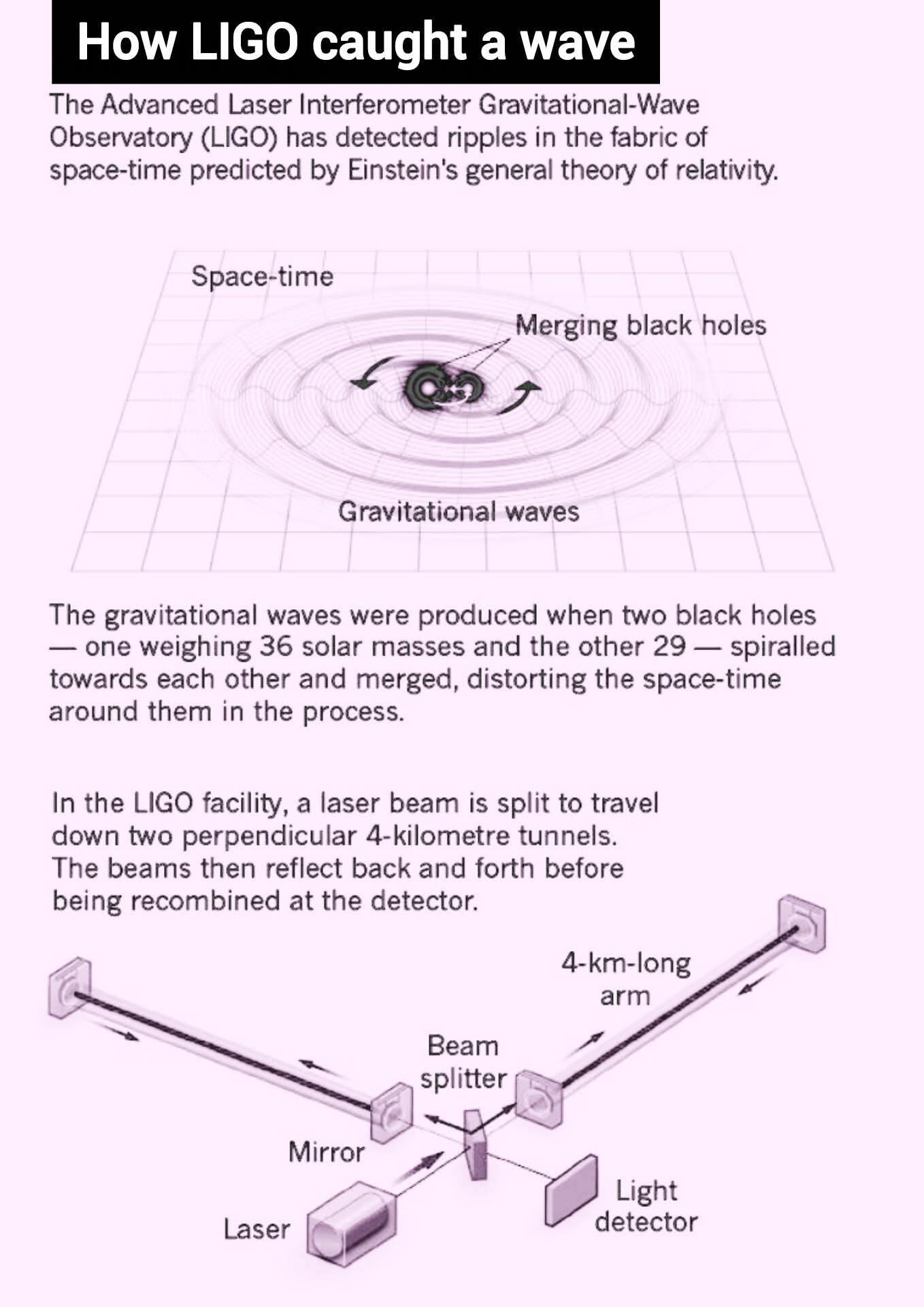
이 이미지는 레이저 간섭계 중력파 관측소(LIGO)가 중력파를 감지하는 방식을 설명하는 다이어그램입니다. 자세한 내용은 다음과 같습니다.
- 제목: LIGO의 중력파 포착 과정
- 설명: 고급 레이저 간섭계 중력파 관측소(LIGO)는 아인슈타인의 일반 상대성 이론에서 예측한 시공간의 파동을 감지했습니다.
- 중력파: 이 다이어그램은 블랙홀이 병합하면서 시공간을 왜곡하는 중력파를 생성하는 모습을 보여줍니다. 이 파동은 두 개의 블랙홀(하나는 태양 질량의 36배, 다른 하나는 29배)이 서로 나선형으로 충돌하여 병합될 때 생성되었습니다.
- LIGO 시설: 레이저 빔이 분리되어 4km 길이의 두 개의 수직 터널을 통과합니다. 빔은 앞뒤로 반사된 후 광 검출기에서 다시 합쳐집니다. 이 그림은 레이저, 빔 분할기, 거울, 4km 길이의 팔, 그리고 빛 검출기를 나타냅니다.
이 그림은 복잡한 과학 개념을 설명하는 유익한 그림입니다.
내용을 고려했을 때, 다음에 누군가 관심을 가질 만한 몇 가지 사항을 소개합니다.
- 레이저 간섭계의 작동 원리를 더 자세히 설명해 주시겠습니까?
- 블랙홀 병합 외에 중력파를 생성하는 다른 원천은 무엇입니까?
- 중력파 검출이 우주에 대한 우리의 이해에 어떤 의미를 갖는가?
LIGO's gravitational wave capture process
This image is a diagram illustrating how the Laser Interferometer Gravitational Wave Observatory (LIGO) detects gravitational waves. Details include:
- Title: LIGO's gravitational wave capture process
- Description: The Advanced Laser Interferometer Gravitational Wave Observatory (LIGO) detected waves in spacetime predicted by Einstein's theory of general relativity.
- Gravitational wave: This diagram shows the black holes merging to create gravitational waves that distort space and time. The wave was created when two black holes (one 36 times the mass of the Sun and the other 29 times the mass) collided in a spiral with each other and merged.
- LIGO facility: The laser beam is separated and passes through two vertical tunnels, 4 km long. The beam is reflected back and forth and then merged back together in the photodetector. This figure shows the laser, the beam splitter, the mirror, the arm 4 km long, and the photodetector.
This picture is a informative one that explains complex scientific concepts.
Considering the content, I will introduce some points that someone might be interested in next time.
- Can you explain the operating principle of the laser interferometer in more detail?
- What other sources generate gravitational waves besides black hole merging?
- What does gravitational wave detection mean to our understanding of the universe?
Gravitational waves are phenomena where the curvature of space-time propagates in the form of waves when a massed object makes an accelerating motion. For the LIGO described in the image, a tremendous acceleration motion occurs in the process of merging two black holes in a spiral motion towards each other, resulting in gravitational waves.
To be more detailed:
- Mass and acceleration: The larger the mass and the greater the acceleration, the more powerful gravitational waves are generated.
- Black hole merger: Black holes have very large masses and produce very powerful gravitational waves because they have enormous accelerations in the process of merging with each other.
- Other sources of gravitational waves: In addition to black hole mergers, violent celestial phenomena such as neutron star mergers and supernova explosions can also generate gravitational waves. It is also estimated that gravitational waves were generated during the period of rapid expansion immediately after the Big Bang.
- Distortion in space-time: Gravitational waves cause distortion in space-time itself, which propagates in the form of waves. LIGO detects these minute distortions in space and time to check the gravitational waves.
In summary, gravitational waves are caused by the accelerating motion of mass-bearing objects, especially violent celestial phenomena such as black hole mergers, which produce powerful gravitational waves. LIGO is contributing to the detection of these gravitational waves, which are gaining new information about the universe.