Magnetic inductance and reciprocal inductance
자기 인덕턴스는 코일 자체 내에서 기전력을 유도하여 전류 변화에 저항하는 코일의 능력인 반면, 상호 인덕턴스는 한 코일의 전류 변화가 근처의 다른 코일에 기전력을 유도하는 현상을 설명합니다. 둘 다 전자기 유도의 한 형태로, 변화하는 자기장이 유도 기전력(EMF)을 유발합니다. 자기 인덕턴스와 상호 인덕턴스의 SI 단위는 모두 헨리(H)입니다.
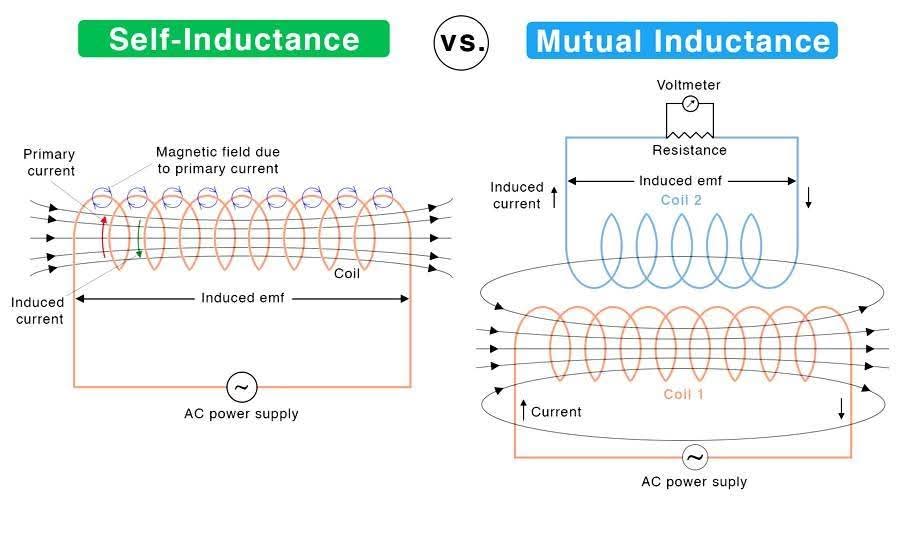
자기 인덕턴스 (인덕턴스)
- 정의:코일을 통과하는 전류의 변화에 저항하게 하는 단일 코일의 특성.
- 메커니즘:코일의 전류가 변하면 변화하는 자기장이 생성됩니다. 이 변화하는 자기장은 다시 원래 전류 변화에 반대하는 전압(EMF)을 동일한 코일에 유도합니다.
- 유추:전류의 가속 또는 감속에 반대하는 "전기 관성"과 같습니다.
- 수학적 표현:코일에 유도된 EMF(V)는 공식 V = -L(dI/dt)로 주어지며, 여기서 L은 인덕턴스이고 dI/dt는 전류 변화율입니다.
상호 인덕턴스
- 의미:한 코일의 전류 변화가 근처의 두 번째 코일에 전압(EMF)을 유도하는 특성.
- 메커니즘:첫 번째(기본) 코일의 전류는 변화하는 자기장을 생성합니다. 이 변화하는 자기장은 두 번째(보조) 코일과 연결되어 EMF를 유도하고 보조 코일에 전류가 흐르게 합니다.
- 응용:이 원리는 회로 간의 전압을 높이거나 낮추기 위해 상호 인덕턴스를 사용하는 변압기 작동의 기본입니다.
- 수학적 표현:상호 인덕턴스(M)는 한 코일의 자기 선속과 다른 코일의 전류의 비율 또는 다른 코일의 전류 변화율당 한 코일에 유도된 EMF로 정의됩니다.
자기 인덕턴스와 상호 인덕턴스의 차이점
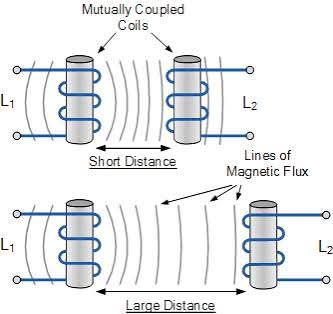
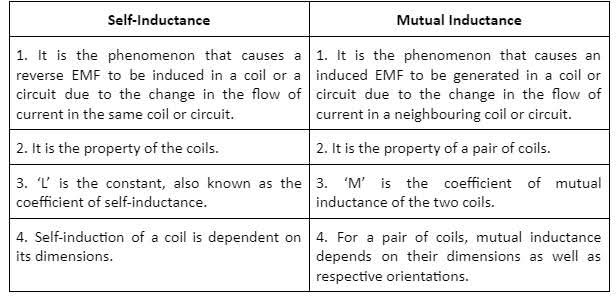
- 관련된 코일 수:자기 인덕턴스는 단일 코일을 포함하는 반면, 상호 인덕턴스는 둘 이상의 상호 작용하는 코일을 포함합니다.
- 유도 위치:자기 인덕턴스에서 유도된 EMF는 전류가 변하는 동일한 코일 내에 있습니다. 상호 인덕턴스에서 유도된 EMF는 근처의 다른 코일에 있습니다.
이미지에 따르면:
- 자기 인덕턴스에서는 주 전류로 인해 코일에서 자기장이 발생하고 유도 전류가 발생합니다. 교류 전원 공급 장치가 필요합니다.
- 상호 인덕턴스에서는 코일 1에서 전류가 발생하여 코일 2에 유도 전류가 발생합니다. 코일 2에는 전압계와 저항이 연결되어 있습니다. 교류 전원 공급 장치가 필요합니다.
THE SELF AND MUTUAL INDUCTANCE
Self-inductance is a coil's ability to oppose a change in its own current by inducing an EMF within itself, while mutual inductance describes the phenomenon where a changing current in one coil induces an EMF in a separate, nearby coil. Both are forms of electromagnetic induction, with a changing magnetic field causing an induced electromotive force (EMF). The SI unit for both self and mutual inductance is the henry (H).
SELF-INDUCTANCE (Inductance)
• Definition:
The property of a single coil of wire that causes it to resist changes in the current flowing through it.
• Mechanism:
When the current in the coil changes, it creates a changing magnetic field. This changing magnetic field, in turn, induces a voltage (EMF) in the same coil that opposes the original change in current.
• Analogy:
It acts like an "inertia of electricity," opposing any acceleration or deceleration of the current.
• Mathematical expression:
The induced EMF (V) in the coil is given by the formula V = -L(dI/dt), where L is the inductance and dI/dt is the rate of change of current.
MUTUAL INDUCTANCE
• Meaning:
The property where a changing current in one coil induces a voltage (EMF) in a second, nearby coil.
• Mechanism:
A current in the first (primary) coil generates a changing magnetic field. This changing magnetic field links with the second (secondary) coil, inducing an EMF and causing a current to flow in the secondary coil.
• Applications:
This principle is fundamental to the operation of transformers, which use mutual inductance to step up or step down voltages between circuits.
• Mathematical expression:
Mutual inductance (M) is defined as the ratio of the magnetic flux in one coil to the current in the other coil, or the induced EMF in one coil per unit rate of change of current in the other coil.
DIFFERENCES BETWEEN SELF AND MUTUAL INDUCTANCE
Number of coils involved:
Self-inductance involves a single coil, while mutual inductance involves two or more interacting coils.
Location of induction:
In self-inductance, the induced EMF is within the same coil that has the changing current. In mutual inductance, the induced EMF is in a different, nearby coil.