Temperature scale in the universe: from cryogenic to ultra-high temperatures
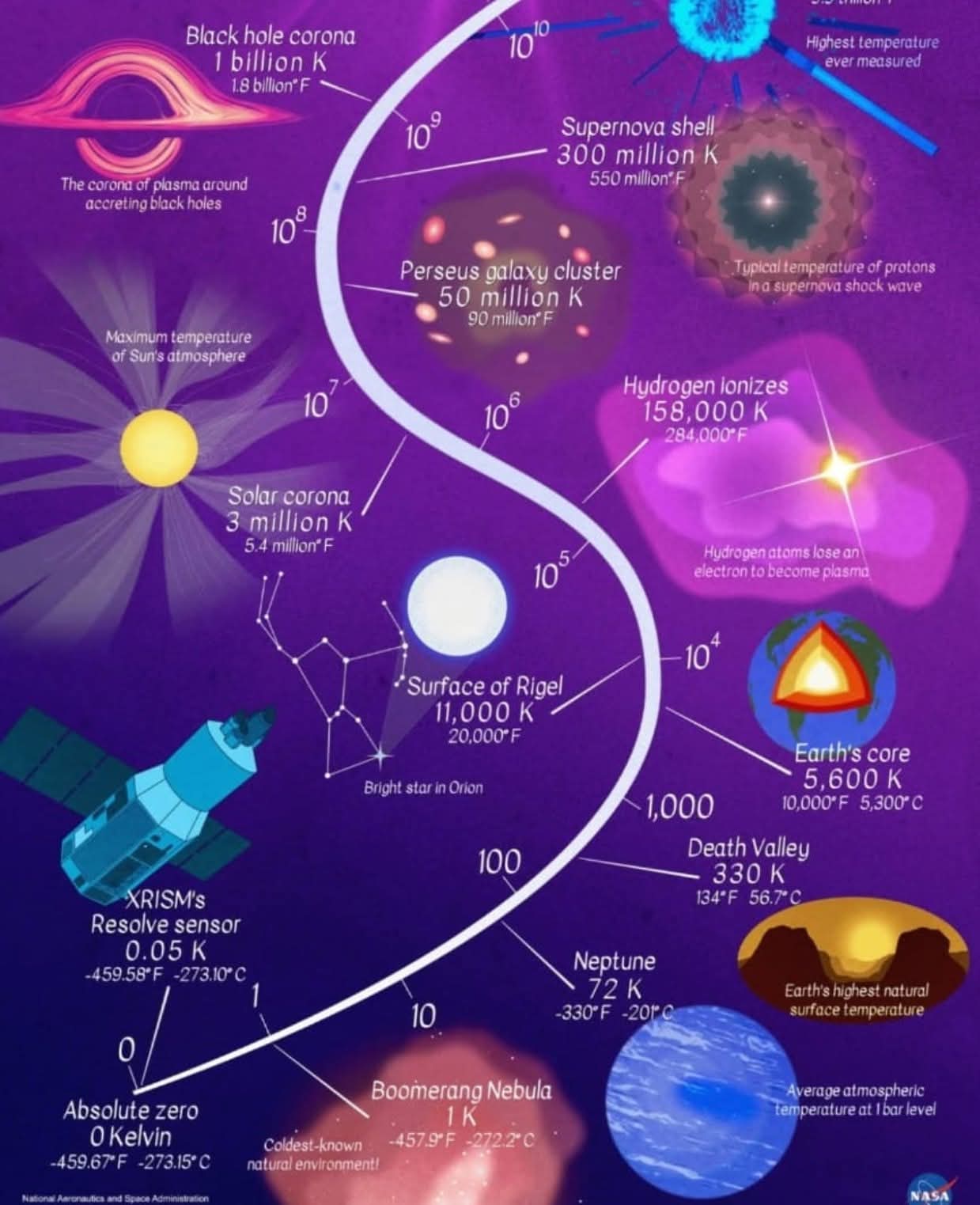
우주는 상상할 수 없을 정도로 다양한 온도를 가진 공간입니다. 절대 영도에 가까운 극저온에서부터 태양의 중심보다 훨씬 뜨거운 초고온까지, 온도 스케일은 우주의 다양한 현상을 이해하는 데 중요한 역할을 합니다. 아래 이미지는 우주의 대표적인 온도들을 비교하여 보여줍니다.
주요 온도 비교
1. 극저온 영역
- 절대 영도 (0 K): -273.15°C (-459.67°F)로, 이론적으로 도달할 수 있는 가장 낮은 온도입니다.
- 부메랑 성운 (1 K): -272.2°C (-457.9°F)로, 알려진 가장 추운 자연 환경입니다.
- XRISM 분해 센서 (0.05 K): -273.10°C (-459.58°F)로, 극저온 상태를 유지하는 센서입니다.
- 해왕성 (72 K): -201°C (-330°F)로, 태양계 행성 중 하나로 매우 추운 환경입니다.
2. 지구 및 태양계 영역
- 데스밸리 (330 K): 56.7°C (134°F)로, 지구에서 가장 높은 자연 표면 온도를 기록한 곳 중 하나입니다.
- 지구 핵 (5,600 K): 5,300°C (10,000°F)로, 지구 내부의 엄청난 열기를 나타냅니다.
- 태양 코로나 (3백만 K): 540만°F로, 태양 대기의 높은 온도를 보여줍니다.
3. 항성 및 은하 영역
- 리겔 표면 (11,000 K): 20,000°F로, 오리온자리에서 밝게 빛나는 별의 표면 온도입니다.
- 수소 이온화 (158,000 K): 284,000°F로, 수소 원자가 플라즈마 상태로 변하는 온도입니다.
- 페르세우스 은하단 (5천만 K): 9천만°F로, 은하들이 모여 있는 거대한 구조의 온도입니다.
- 초신성 껍질 (3억 K): 5억 5천만°F로, 초신성 폭발 후 팽창하는 물질의 온도입니다
- 블랙홀 코로나 (10억 K): 18억°F로, 블랙홀 주변 플라즈마의 엄청난 열기를 나타냅니다.
우주의 온도 스케일
Tip : 켈빈(K)은 과학에서 주로 사용되는 절대 온도 단위로, 0 K는 절대 영도를 의미합니다.
한글번역
*The Interconnected Realms of Cosmic Inquiry: Astronomy, Astrophysics, and Cosmology*
The terms astronomy, astrophysics, and cosmology are often used interchangeably, but they represent distinct yet deeply interconnected fields of study, each with a unique focus and methodology. Understanding their differences clarifies how a single deep space mission to a planet synthesizes all three disciplines.
Astronomy is the oldest of these sciences, primarily concerned with the observational aspects of celestial objects. It focuses on mapping positions, measuring movements, tracking brightness, and cataloguing phenomena. It answers the "what," "where," and "when." An astronomer might precisely measure the orbit of a planet, the periodic dimming of its host star, or its apparent brightness.
Astrophysics is the branch of astronomy that applies the laws of physics and chemistry to understand the nature of these celestial objects. It seeks to explain the "how." An astrophysicist takes the data provided by astronomy and uses principles like thermodynamics, magnetism, and gravity to decipher the physical processes at work. They investigate a planet's atmospheric composition, model its internal structure, or calculate the forces that shape its geology.
Cosmology operates on the grandest scale. It is the study of the origin, evolution, and ultimate fate of the entire universe. Rather than focusing on individual objects, cosmology treats the universe as a single physical entity. It addresses the biggest questions: What is the nature of dark matter and dark energy? How did the universe begin? How did large-scale structures like galaxies form?
A deep space exploration mission to a planet, such as sending an orbiter and a lander to Mars, beautifully demonstrates the synergy between these fields at different stages.
The initial "astronomical" phase involves pinpointing the planet's location with extreme precision for navigation. Prior to launch, Earth-based telescopes have already performed extensive astronomy, charting the planet's orbital path over years to identify the optimal launch window. During the cruise and orbital insertion, navigators use star trackers—a modern form of celestial navigation—which is a fundamental astronomical practice.
Once the spacecraft is in orbit, the mission transitions heavily into the "astrophysical" phase. Instruments onboard are not just taking pictures; they are collecting astrophysical data. A spectrometer analyzes the chemical makeup of the atmosphere, applying physical principles to identify gases. A magnetometer measures the planet's magnetic field. A radar sounder probes beneath the surface to determine the structure of the ice caps. Each of these instruments is designed to answer specific physical questions about how the planet functions, evolves, and interacts with solar radiation.
Finally, the data gathered contributes profoundly to "cosmology". Planets are the byproducts of star and solar system formation. By studying the geology and composition of other planets, we test our theories of how planetary systems coalesce from protoplanetary disks. Understanding the atmospheric evolution of Venus, Earth, and Mars provides crucial data points on planetary habitability, which feeds into the cosmological question of how common life might be in the universe. Examining ancient rocks on Mars offers a glimpse into conditions in the early solar system, a minor chapter in the larger cosmological story of the universe.
Thus, a planetary mission relies on astronomy for navigation and discovery, uses astrophysics to understand the planet's physics and chemistry, and ultimately contributes its findings to cosmology, helping to refine our grandest models of the universe's history and composition.
Editorial Bridge of Love and Compassion