CRYSTALLINE SOLIDS
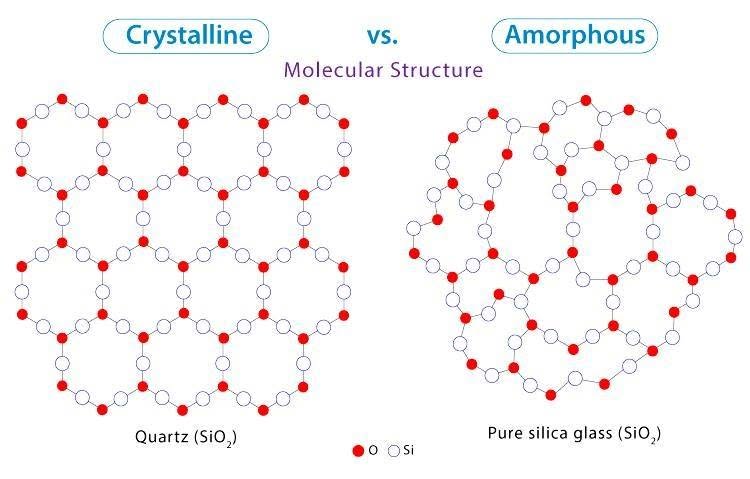
In crystalline solids, the constituent particles, like atoms, ions, or molecules, are arranged in a regular, repeating three-dimensional pattern. This orderly structure, known as crystal lattice, gives these solids their distinct shapes and physical properties.
For example, diamond is a crystalline solid in which carbon atoms are arranged in a rigid, repeating three-dimensional network.
PROPERTIES OF CRYSTALLINE SOLIDS
➡️Regular pattern throughout:
The particles are arranged in a regular, repeating pattern that extends throughout the entire structure. This orderly arrangement is known as long-range order. For example, ice is composed of H2O molecules arranged in a well-defined lattice that spans the crystal entirely.
➡️Definite shape and edges:
Crystalline solids have well-defined geometric shapes and flat surfaces (faces) with characteristic angles. These features arise from the uniform and periodic arrangement of particles within the lattice.
➡️Sharp melting point:
They melt at a specific, fixed temperature because the forces holding the particles together are of uniform strength. Therefore, during melting, all bonds break simultaneously. For instance, ice melts sharply at 0 °C (32 °F).
➡️Direction-dependent properties:
They exhibit different physical properties, such as electrical conductivity, refractive index, and mechanical strength, along different directions. This directional dependence is called anisotropy and results from the variation in particle arrangement along different axes.
➡️Cleavage along fixed planes:
When broken, many crystalline solids tend to cleave along specific planes of weakness. These cleavage planes correspond to layers in the crystal where repulsion between ions or weaker interactions exist. The resulting surfaces reflect the internal symmetry of the lattice.
➡️Rigidity:
They are rigid due to the strong intermolecular or interionic forces that hold their particles firmly in place, preventing them from deforming easily.
➡️Distinct diffraction patterns:
They produce sharp and well-defined diffraction patterns when exposed to X-rays. It occurs because the regular atomic arrangement causes constructive and destructive interference of the diffracted waves, revealing the crystal’s internal structure.
TYPES OF CRYSTALLINE SOLIDS
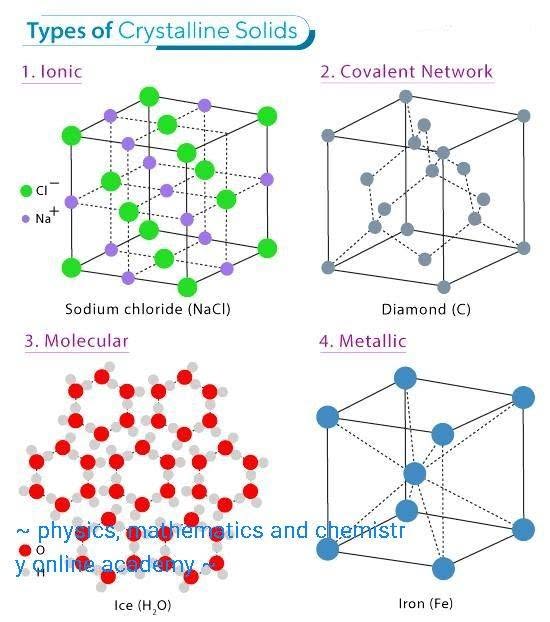
Crystalline solids are classified into four main types based on the nature of their particles and the type of bonding between them.
1. Ionic Solids
They consist of positive and negative ions held together by strong electrostatic (ionic) bonds, forming a rigid lattice.
Examples
• Sodium chloride (NaCl):
Common table salt, used in food seasoning and preservation.
• Magnesium oxide (MgO):
Used as a refractory material in furnaces due to its high melting point.
2. Covalent Network Solids
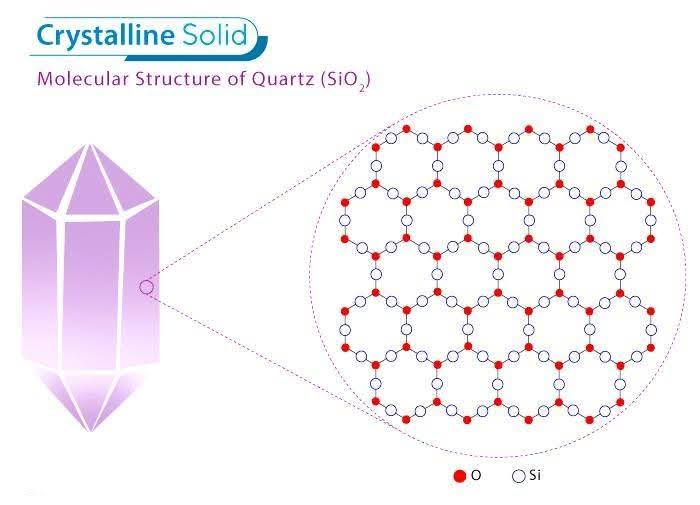
They are composed of atoms connected by covalent bonds in a continuous network, making them resilient with high melting points.
Examples
• Diamond (C):
Used in cutting tools and drills due to its unmatched hardness.
• Quartz (SiO2):
Used in watches and electronics for its piezoelectric properties.
3. Molecular Solids
These solids consist of neutral molecules held together by intermolecular forces, such as van der Waals forces or hydrogen bonding.
Examples
• Ice (H2O):
Used for cooling and refrigeration due to its low melting point.
• Iodine (I2):
Used as an antiseptic in medical applications.
4. Metallic Solids
They consist of metal cations surrounded by a “sea of delocalized electrons,” allowing electrons to move freely.
Examples
• Copper (Cu):
Used in electrical wiring because it conducts electricity well.
• Iron (Fe):
Used in construction and machinery for its strength and durability.
Crystalline solids are characterized by their orderly arrangement of particles. Understanding their types and structure helps explain their widespread use in materials, electronics, and everyday applications. Their comparison with amorphous solids further highlights the importance of atomic arrangement in determining the properties of matter.
결정성 고체
결정성 고체에서 원자, 이온 또는 분자와 같은 구성 입자는 규칙적이고 반복적인 3차원 패턴으로 배열됩니다. 결정 격자라고 하는 이 질서 정연한 구조는 이러한 고체에 뚜렷한 모양과 물리적 특성을 부여합니다.
예를 들어 다이아몬드는 탄소 원자가 단단하고 반복적인 3차원 네트워크로 배열된 결정성 고체입니다.
결정성 고체의 특성
➡️전체에 걸친 규칙적인 패턴:
입자는 전체 구조에 걸쳐 확장되는 규칙적이고 반복적인 패턴으로 배열됩니다. 이 질서 정연한 배열을 장거리 질서라고 합니다. 예를 들어 얼음은 결정 전체에 걸쳐 잘 정의된 격자로 배열된 H2O 분자로 구성됩니다.
➡️명확한 모양과 모서리:
결정성 고체는 특징적인 각도를 가진 잘 정의된 기하학적 모양과 평평한 표면(면)을 가지고 있습니다. 이러한 특징은 격자 내 입자의 균일하고 주기적인 배열에서 비롯됩니다.
➡️날카로운 녹는점:
입자를 함께 묶는 힘이 균일한 강도를 가지므로 특정 고정 온도에서 녹습니다. 따라서 용융 중에는 모든 결합이 동시에 끊어집니다. 예를 들어 얼음은 0 °C(32 °F)에서 날카롭게 녹습니다.
➡️방향 의존적 속성:
전기 전도도, 굴절률 및 기계적 강도와 같은 다양한 물리적 속성을 다양한 방향으로 나타냅니다. 이러한 방향 의존성을 이방성이라고 하며 다른 축을 따라 입자 배열의 변화로 인해 발생합니다.
➡️고정된 평면을 따라 쪼개짐:
파손될 때 많은 결정성 고체는 특정 약점 평면을 따라 쪼개지는 경향이 있습니다. 이러한 쪼개짐 평면은 이온 간의 반발 또는 더 약한 상호 작용이 존재하는 결정의 층에 해당합니다. 결과 표면은 격자의 내부 대칭을 반영합니다.
➡️강성:
입자를 제자리에 단단히 고정하여 쉽게 변형되지 않도록 하는 강한 분자간 또는 이온간 힘으로 인해 단단합니다.
➡️뚜렷한 회절 패턴:
X선에 노출되면 날카롭고 잘 정의된 회절 패턴을 생성합니다. 규칙적인 원자 배열이 회절파의 건설적 및 파괴적 간섭을 일으켜 결정의 내부 구조를 드러내기 때문에 발생합니다.
결정성 고체의 유형
결정성 고체는 입자의 본질과 그 사이의 결합 유형에 따라 네 가지 주요 유형으로 분류됩니다.
1. 이온성 고체
강한 정전기적(이온) 결합으로 함께 유지되는 양이온과 음이온으로 구성되어 단단한 격자를 형성합니다.
예
• 염화나트륨(NaCl):
식품 조미료 및 보존에 사용되는 일반적인 식탁용 소금.
• 산화마그네슘(MgO):
높은 녹는점으로 인해 용광로에서 내화물로 사용됩니다.
2. 공유 네트워크 고체
공유 결합으로 연속적인 네트워크로 연결된 원자로 구성되어 탄력 있고 녹는점이 높습니다.
예
• 다이아몬드(C):
비교할 수 없는 경도로 인해 절단 도구 및 드릴에 사용됩니다.
• 석영(SiO2):
압전 특성으로 인해 시계 및 전자 제품에 사용됩니다.
3. 분자성 고체
이러한 고체는 반 데르 발스 힘 또는 수소 결합과 같은 분자간 힘에 의해 함께 유지되는 중성 분자로 구성됩니다.
예
• 얼음(H2O):
낮은 녹는점으로 인해 냉각 및 냉동에 사용됩니다.
• 요오드(I2):
의료 응용 분야에서 살균제로 사용됩니다.
4. 금속성 고체
전자가 자유롭게 이동할 수 있도록 "비편재화된 전자의 바다"로 둘러싸인 금속 양이온으로 구성됩니다.
예
• 구리(Cu):
전기를 잘 전도하기 때문에 전선에 사용됩니다.
• 철(Fe):
강도와 내구성으로 인해 건설 및 기계에 사용됩니다.
결정성 고체는 입자의 질서 정연한 배열이 특징입니다. 유형과 구조를 이해하면 재료, 전자 제품 및 일상적인 응용 분야에서 널리 사용되는 이유를 설명하는 데 도움이 됩니다. 비정질 고체와의 비교는 물질의 특성을 결정하는 데 있어 원자 배열의 중요성을 더욱 강조합니다.
참고 이미지 :

1. 아래 두 파일을 로컬에 다운로드함
2. Dowoload폴더에서 문서포맷 열기에서 html파일 열기해주세요.
기획 편집정리 : 사랑과 연민의 다리