Einstein's photoelectric effect
아인슈타인의 광전 효과 설명은 빛에 대한 이해를 바꿨습니다. 이전에는 많은 과학자들이 빛이 파동으로만 행동한다고 믿었습니다. 아인슈타인은 빛이 광자(photon)라고 불리는 작은 에너지 덩어리로도 작용한다고 제안했습니다. 이 아이디어는 빛이 금속 표면에서 전자를 쫓아내는 이유를 설명하는 데 도움이 되었으며, 양자 이론의 시작을 알렸습니다.
핵심 방정식은 hν = φ + KEmax입니다. hν 항은 입사하는 광자의 에너지를 나타냅니다. 일함수(φ)는 금속에서 전자를 자유롭게 하기 위해 필요한 에너지입니다. 남은 에너지는 방출된 전자의 운동 에너지가 됩니다. 이 방정식은 이 과정에서 에너지가 정확히 어떻게 분배되는지 보여줍니다.
아인슈타인은 또한 빛의 밝기를 높여도 항상 광전자를 생성하지 않는 이유도 설명했습니다. 충분히 높은 주파수를 가진 빛만이 전자를 방출할 수 있습니다. 주파수가 너무 낮으면 빛이 아주 밝아도 전자가 나타나지 않습니다. 이 결과는 당시 놀라운 것이었으며, 광자 개념에 대한 강력한 증거를 제공했습니다.
이 법칙은 또한 방출된 전자의 속도가 밝기가 아니라 주파수에 의존하는 이유도 설명합니다. 주파수가 높을수록 광자 에너지가 높아집니다. 이는 전자가 금속을 탈출한 후 더 많은 남은 에너지를 갖게 합니다. 이 효과는 에너지가 부드러운 흐름이 아니라 불연속적인 양으로 존재한다는 것을 확인하는 데 도움이 되었습니다.
광전 효과에 대한 아인슈타인의 연구는 그에게 노벨상을 가져왔습니다. 이는 양자 역학의 길을 열고 물리학을 영원히 바꿨습니다. 광자 개념은 이제 태양 전지, 카메라, 레이저와 같은 많은 기술을 지원하고 있습니다. 그의 간단한 방정식은 빛과 물질에 대한 깊은 진리를 밝히고 현대 과학의 초석으로 남아 있습니다.
참고: 방정식에서 사용된 기호는 국제적으로 통용되는 표기법을 따랐으며, "h"는 플랑크 상수, "ν"(뉴)는 주파수, "φ"(파이)는 일함수를 의미합니다.

이미지에 있는 주요 수식들
1. E = hf (광자 에너지)
- E: 광자의 에너지
- h: 플랑크 상수 (자연의 기본 상수, 약 6.626×10⁻³⁴ J·s)
- f: 빛의 주파수 (단위 시간당 파동의 수)
- 설명: 빛이 광자로 이루어졌을 때, 각 광자의 에너지는 빛의 주파수에 비례한다는 뜻입니다. 주파수가 높을수록 광자 에너지가 커집니다.
2. Work Function (Φ, 일함수)
- Φ: 금속에서 전자를 표면 밖으로 내보내기 위해 필요한 최소 에너지
- 설명: 금속 안의 전자는 금속 원자들에 붙어 있으므로, 이를 자유롭게 하려면 일정한 에너지가 필요합니다. 이 최소 에너지를 일함수라고 부릅니다. 금속 종류에 따라 값이 다릅니다.
3. KE = E - Φ (전자 운동 에너지)
- KE: 방출된 전자의 최대 운동 에너지
- 설명: 입사한 광자의 에너지(E) 중에서 일함수(Φ)만큼을 사용해 전자를 자유롭게 한 후, 남은 에너지가 전자의 운동 에너지로 변한다는 뜻입니다. 광자 에너지가 일함수보다 작으면 전자가 방출되지 않습니다.
이 세 가지 수식이 함께 광전 효과의 핵심 원리를 설명하는 아인슈타인의 방정식 시스템을 이룹니다.
이미지에 포함된 텍스트 번역:
- QUANTUM PHYSICS: 양자 물리학
- E = hf (Photon Energy): E = hf (광자 에너지)
- Work Function (Φ): 일함수 (Φ)
- KE = E - Φ (Electron Kinetic Energy): KE = E - Φ
(전자 운동 에너지)
- Einstein showed that light comes in photons and that a photon energy frees an electron then leaves extra energy as motion which became the photoelectric law: 아인슈타인은 빛이 광자로 이루어져 있으며, 광자 에너지가 전자를 떼어내고 남은 에너지는 운동 에너지로 전환되어 광전 효과 법칙이 된다는 것을 보여주었습니다.
한글번역
Einstein explanation of the photoelectric effect changed the understanding of light. Before this many scientists believed light behaved only like a wave. Einstein proposed that light also acts as small packets of energy called photons. This idea helped explain why light can knock electrons out of a metal surface. It marked the beginning of quantum theory.
The key equation is h nu equals phi plus K E max. The term h nu represents the energy of the incoming photon. The work function phi is the energy needed to free an electron from the metal. The remaining energy becomes the kinetic energy of the ejected electron. This equation shows exactly how energy is divided in the process.
Einstein also explained why increasing the brightness of light does not always produce photoelectrons. Only light with a high enough frequency can release electrons. If the frequency is too low no electrons appear even if the light is very bright. This result was surprising at the time and gave strong evidence for the idea of photons.
The law also explains why the speed of ejected electrons depends on the frequency rather than the brightness. Higher frequency means higher photon energy. This gives electrons more leftover energy after escaping the metal. The effect helped confirm that energy comes in discrete amounts rather than a smooth flow.
Einstein work on the photoelectric effect earned him the Nobel Prize. It opened the path to quantum mechanics and changed physics forever. The idea of photons now supports many technologies such as solar cells cameras and lasers. His simple equation revealed a deep truth about light and matter and remains a cornerstone of modern science.
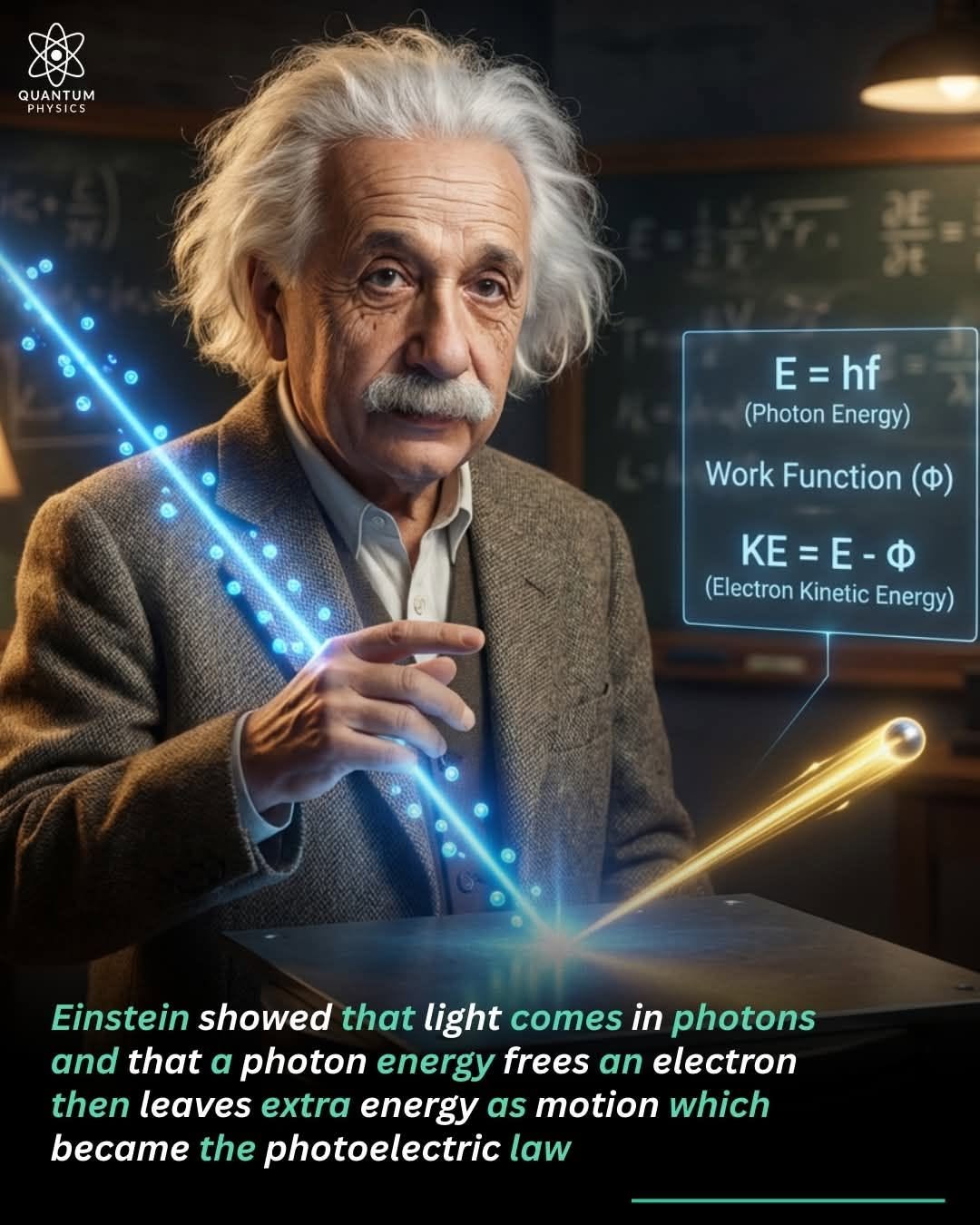
A beam of light, rendered in bright blue, shines onto a metallic surface. Upon contact, a golden ray shoots off, illustrating the photoelectric effect where light (photons) knocks electrons off a metal surface. Accompanying the illustration are the equations that describe the photoelectric effect.
If you're interested, I could provide more details on:
- The history of the photoelectric effect
- The real-world applications of the photoelectric effect
- The impact of the photoelectric effect on quantum physics
채널링 : 사랑과 연민의 다리