끈 이론은 물리학의 한 틀로서, 기본 입자들이 점이 아니라 매우 작은 1차원 진동하는 "끈"으로 이루어져 있다고 제안합니다. 끈의 다양한 진동 패턴은 전자, 쿼크와 같은 서로 다른 입자들을 생성하며, 중력을 양자 역학과 통합하려는 시도입니다. 이는 "만물 이론"으로 불리지만, 수학적으로 복잡하고 실험적으로 증명되지 않았으며, 추가적인 차원과 실험을 위한 매우 높은 에너지를 필요로 합니다.
끈 이론은 우주가 현재와 같은 모습인 이유와 방법에 대한 문제에 접근하려는 이론적 틀입니다. 끈 이론에서는 점과 같은 입자들이 끈이라고 불리는 1차원 개체로 대체됩니다. 끈 이론은 이러한 미세한 끈들이 어떻게 이동하고 서로 상호 작용하는지 설명합니다. 일반적인 고전적 거리 척도(끈 척도보다 큰)에서 끈은 전하, 질량 및 기타 특성을 가진 일반적인 입자와 매우 유사합니다. 끈의 특성은 진동 상태에 의해 직접적으로 제어됩니다.
초끈 이론에는 여러 버전이 있습니다.
- Type I
- Type IIA
- Type IIB
- Heterotic string theory (SO(32))
- Heterotic string theory (E8×E8)
다양한 버전은 서로 다른 끈 집합을 가지고 있습니다. 낮은 에너지 수준에서 형성되는 입자는 다양한 대칭성을 나타냅니다.
Heterotic, TypeIIB 및 TypeIIA 이론은 닫힌 끈만으로 구성됩니다. 그러나 Type I은 닫힌 끈과 열린 끈을 모두 포함합니다.
핵심 개념
- 점이 아닌 끈: 기본 구성 요소는 0차원 점 대신 1차원 끈(작은 고무 밴드와 유사)입니다.
- 진동이 입자를 결정: 특정 방식으로 진동하는 끈은 전자, 다른 방식으로 진동하는 끈은 쿼크, 광자 또는 심지어 중력자(중력을 매개하는 입자)가 됩니다.
- 통합: 아인슈타인의 일반 상대성 이론(거시적 규모, 중력)과 양자 역학(미시적 규모)을 하나의 틀로 통합하여 모든 힘과 물질을 통합하는 것을 목표로 합니다.
- 추가 차원: 끈 이론은 우리가 익숙한 3차원 공간(및 시간) 이상을 요구합니다. 이러한 추가 차원은 매우 작게 "압축"되어 있다고 생각됩니다.
현황 및 과제
- 수학적 틀: 강력한 수학적 아이디어이지만 직접적인 실험적 증거가 부족합니다.
- 실험적 어려움: 끈을 "보기" 위해 필요한 에너지는 LHC와 같은 현재의 입자 가속기의 능력을 훨씬 뛰어넘습니다.
- 랜드스케이프 문제: 무수히 많은 가능한 수학적 해(진공)가 있어 우리 우주를 설명하는 해를 정확히 찾아내기 어렵습니다.
중요성
- 중력을 양자 이론과 병합하는 물리학의 가장 큰 퍼즐에 대한 잠재적인 해결책을 제공합니다.
- 겉보기에 관련이 없는 수학 및 물리학 분야를 연결합니다.
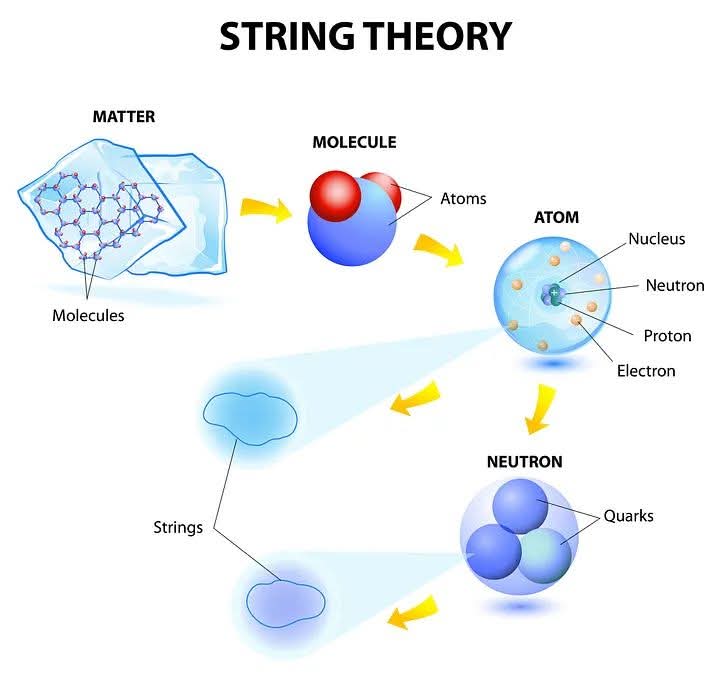
THE STRING THEORY
String theory is a physics framework proposing that fundamental particles aren't points but tiny, one-dimensional vibrating "strings," with different vibration patterns creating different particles (like electrons, quarks) and unifying gravity with quantum mechanics—a "Theory of Everything" that remains mathematically complex and experimentally unproven, requiring extra dimensions and incredibly high energies to test.
String theory is a theoretical framework that tries to tackle the problems of how and why the universe is like what it is now. In string theory, point-like particles are replaced by one-dimensional entities called strings. String theory explains how these infinitesimal strings travel and interact with each other. In normal classical distance scales (larger than the string scale), a string is very similar to a normal particle with its charge, mass and other characteristics. The characteristics of strings are directly controlled by their vibrational states.
There are many versions of superstring theory.
Type I
Type IIA
Type IIB
Heterotic string theory (SO(32)
Heterotic string theory (E8×E8)
The various versions have different sets of strings. The particles that form at low energy levels show varied symmetries.
Heterotic, TypeIIB and TypeIIA theory consists of only closed strings. However, Type I consists of both closed and open strings.
Core Concepts
Strings, Not Points:
Instead of zero-dimensional points, fundamental constituents are 1D strings (like tiny rubber bands).
Vibration Determines Particle:
A string vibrating one way is an electron; vibrating another way, it's a quark, a photon, or even a graviton (the particle for gravity).
Unification:
It aims to reconcile Einstein's general relativity (large scale, gravity) with quantum mechanics (small scale) into one framework, unifying all forces and matter.
Extra Dimensions:
String theory requires more than our familiar three spatial dimensions (plus time); these extra dimensions are thought to be "compactified" (curled up) very small.
Status & Challenges
• Mathematical Framework:
It's a powerful mathematical idea but lacks direct experimental proof.
• Experimental Difficulty:
The energies needed to "see" strings are far beyond current particle accelerators like the LHC.
• The Landscape Problem:
There are countless possible mathematical solutions (vacua), making it hard to pinpoint which describes our universe.
• Why It Matters
It offers a potential solution to the biggest puzzle in physics: merging gravity with quantum theory.
It connects seemingly unrelated fields of mathematics and physics.
채널링 사랑과 연민의 다리