Does information create the world? The essence revealed by theoretical physics.
요즘 이론 물리학의 아주 극단적인 관점 중 하나가 있는데요. 우리가 평소에 "정보"라고 생각하는 게 단순히 설명하는 도구가 아니라, 세상의 가장 기본적인 구성 요소라는 거예요. 마치 우리가 보는 모든 물건이 원자로 이뤄진다고 알고 있듯, 이 관점에서는 물질이나 에너지, 공간과 시간마저도 더 깊은 곳에 있는 "정보 구조"의 모습일 뿐이라고 말해요.
어떤 의미인지 예를 들어볼게요. 우리가 놀이터에서 친구들과 하는 규칙 게임을 생각해 보세요. 공이 어떻게 움직이느냐, 누가 어떤 역할을 하느냐는 게임 규칙에 따라 달라죠? 이 관점에서 물리 법칙도 마찬가지로 정보를 처리하는 규칙이라고 보는 거예요. 그리고 우리가 아는 원자나 입자들은 그냥 정보의 특정 상태나 "활동 모습"이라고 할 수 있죠.
이렇게 생각하면 평소에 어렵게 느껴지는 개념들도 새롭게 보이게 돼요. 예를 들어 "엔트로피"는 정보의 혼잡도라고, "양자 얽힘"은 정보가 서로 연결돼 있다고 이해할 수 있고요. 심지어 양자 컴퓨터 같은 기술도 이런 정보 구조를 활용하는 방식이라 할 수 있죠.
더 신기한 건 공간과 시간까지도 정보 간의 연결 패턴에서 나온다고 보는 거예요. 마치 스마트폰 화면에 보이는 그림이 내부 회로의 전기 신호 관계에서 나오는 것처럼요. 심지어 온 우주도 한정된 규칙을 가진 컴퓨터 시스템이라고 볼 수 있고, 우리가 생각하는 모든 건 그 안에서 정보가 처리되는 결과일 뿐이라고 해요.
이런 생각은 우주론부터 양자 중력, 정보 이론까지 연결시키면서 아주 강렬한 질문을 던져요.
👉 우리가 사는 우주가 정보를 "담고 있는" 게 아니라, 우주 자체가 "정보"인 거 아닐까?
마치 세상이 철이나 나무로 이뤄진 게 아니라, 수많은 "글자"나 "부호"들이 서로 연결되어 우리가 보는 모습을 만들어내는 것처럼요. 어쩌면 이 우주가 결국은 하나의 거대한 정보 시스템일지도 모르는 거죠.
#fblifestyle
《정보로서의 우주》
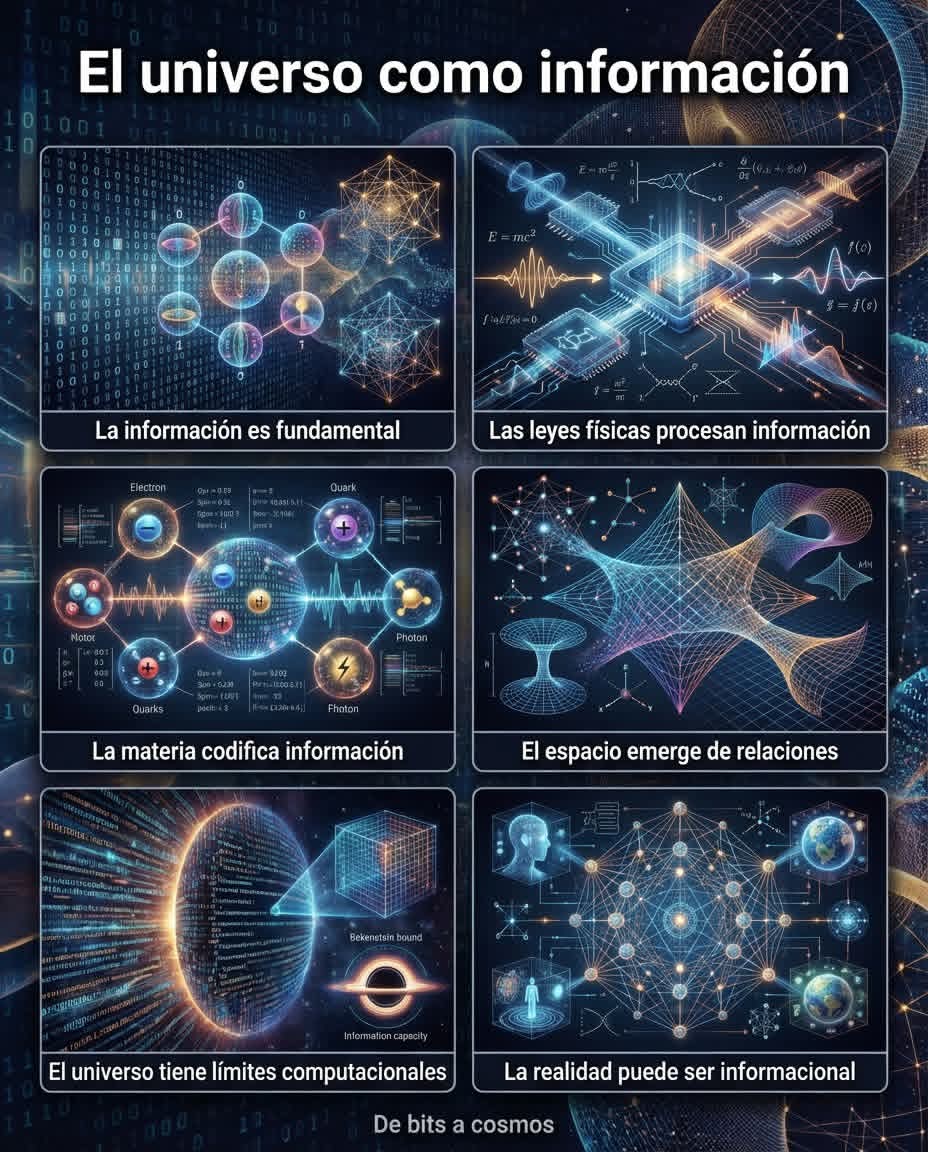
In some cutting-edge corners of theoretical physics, information isn’t just a tool we use to describe the world around us – it’s thought to be the basic building block of everything that exists. Think of it this way: we’ve long believed all matter is made of atoms, but from this perspective, even matter, energy, space, and time are just visible "expressions" of deeper information structures.
To make this easier to grasp, imagine a board game. The rules of the game dictate how pieces move and interact, right? In this view, the laws of physics work like those game rules – they’re the guidelines for processing information. And tiny particles like electrons or photons? They’re like specific "states" or "active patterns" of that information.
This shift in thinking puts concepts like entropy (which we can think of as the "messiness" of information), quantum entanglement (where particles share information across distances), and quantum computing front and center in how we understand the universe.
Even the shape and nature of space-time might come from the way information units connect and correlate with one another. It’s similar to how a social network forms when people link up – the structure of the network emerges from those relationships, not the other way around. Some theories even suggest the entire universe acts like a finite computer system, with built-in limits to how much information it can hold and process.
This way of looking at things ties together cosmology, quantum gravity, information theory, and philosophy – and it leads to a pretty radical idea:
👉 We don’t live in a universe that contains information. Instead, we live in a universe that is information.
What if reality isn’t made of stuff like rocks or stars, but of information itself? Some theories propose the universe processes bits (the basic units of classical information) and qubits (the building blocks of quantum information), with space and time growing out of those connections.
Maybe, at its core, the cosmos is one vast information system.
#fblifestyle
이미지설명:
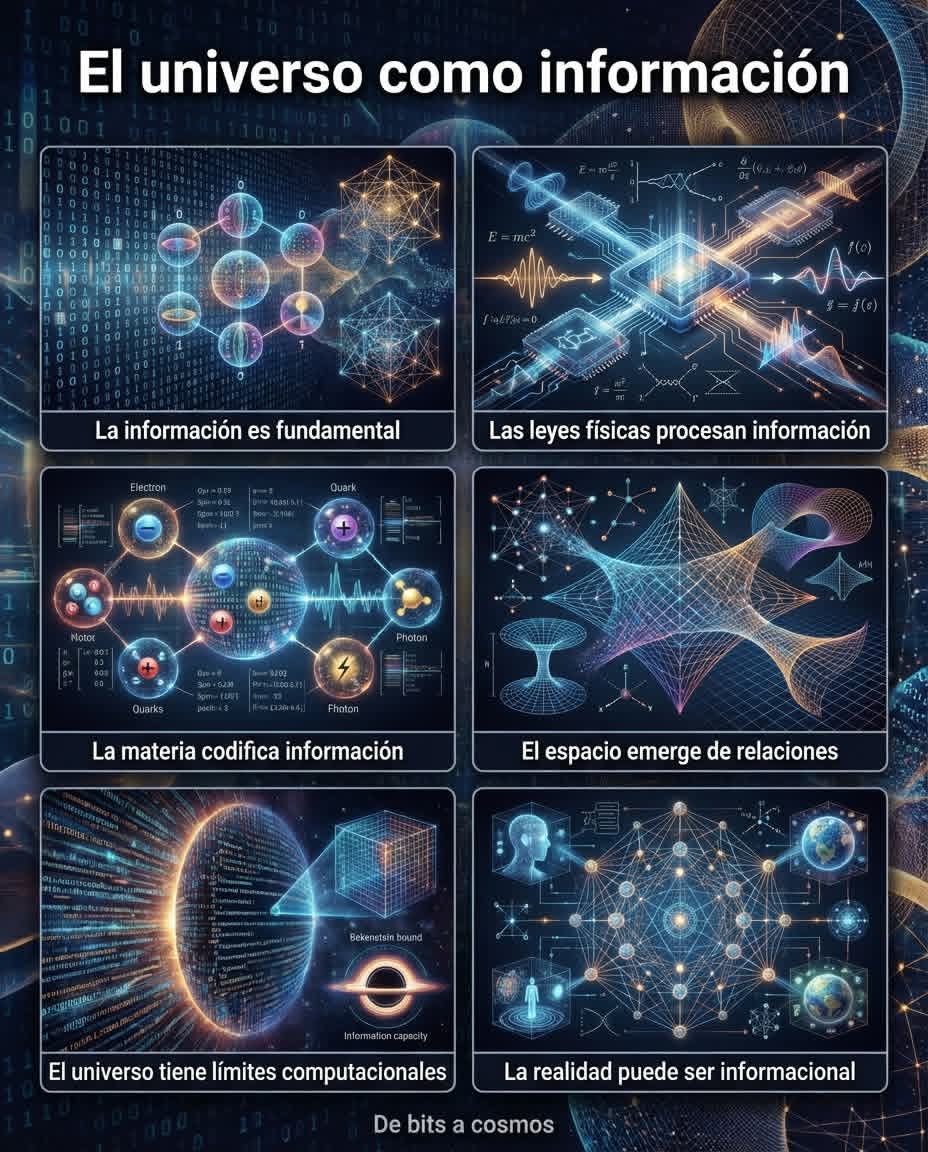
이미지 제목: El universo como información
(정보로서의 우주)
설명: 우리가 사는 우주가 물질이나 에너지로만 이뤄진 게 아니라, 그보다 근본적인 "정보"를 기반으로 만들어졌다는 핵심 아이디어를 전달합니다. 마치 책 속 이야기가 글자(정보)로 이뤄진 것처럼, 우주 전체도 정보의 구조와 관계에서 비롯된 것이라고 보는 이론적 관점을 담고 있죠.
Explanation: It conveys the core idea that the universe we live in is not made solely of matter or energy, but rather is created based on more fundamental "information." It contains a theoretical perspective that the entire universe originates from the structure and relationships of information, much like the stories in books are made up of letters (information).
1. La información es fundamental
번역: 정보는 근본적이다
그림설명: 정보가 단순히 것을 설명하는 도구가 아니라, 현실 세계의 가장 기본적인 구성 요소라는 뜻입니다. 예를 들어 우리가 보는 모든 사물이 원자로 이뤄진다고 생각하듯, 이 관점에서는 물질·에너지·공간·시간 모두 더 깊은 정보 구조의 모습일 뿐이라고 설명해요. 그림 속 원자 모양과 이진수 코드는 "정보가 세상의 뿌리"라는 개념을 시각적으로 보여줍니다.
Illustration: It means that information is not simply a tool to explain things, but rather the most basic components of the real world. For example, just as we think that everything we see is made up of atoms, from this perspective, matter, energy, space, and time are all just aspects of deeper information structures. The atomic shapes and binary codes in the picture visually illustrate the concept that "information is the root of the world."
2. Las leyes físicas procesan información
번역: 물리 법칙은 정보를 처리한다
설명: 자연계의 모든 법칙(예: 중력, 양자 역학 등)은 마치 컴퓨터 프로그램의 규칙처럼 정보를 다루고 변환하는 역할을 한다고 봅니다. 그림 속 공식과 파동 패턴은 "물리 현상이 결국 정보의 처리 과정"임을 나타내죠. 마치 놀이터 게임 규칙이 아이들의 움직임을 정하는 것처럼, 물리 법칙이 정보의 흐름을 이끄는 거예요.
Explanation: I believe that all the laws of nature (e.g., gravity, quantum mechanics, etc.) play a role in handling and transforming information, much like the rules of a computer program. The formula and wave pattern in the figure indicate that "physical phenomena are ultimately processes of information processing." Just as playground game rules determine children's movements, the laws of physics guide the flow of information.
3. La materia codifica información
번역: 물질은 정보를 암호화한다
설명: 원자·전자·광자 같은 입자들은 정보를 담고 있는 "암호화된 형태"라고 볼 수 있습니다. 각 입자의 성질(전하·질량 등)은 특정 정보를 나타내며, 이들이 서로 어떻게 연결되느냐에 따라 다양한 물질이 만들어져요. 그림 속 입자 구조와 수치는 "물질이 정보의 표현체"라는 점을 보여줍니다.
Description: Particles such as atoms, electrons, and photons can be considered "encrypted forms" that contain information. The properties of each particle (such as charge and mass) represent specific information, and various materials are created depending on how they are connected to each other. The particle structure and figures in the picture show that "matter is an expression of information."
4. El espacio emerge de relaciones
번역: 공간은 관계에서 비롯된다
설명: 우리가 느끼는 "공간"이라는 개념도 정보 간의 연결 관계에서 나온다고 설명합니다. 마치 소셜 네트워크에서 사람들이 서로 연결되며 커뮤니티가 생기듯, 정보 단위들이 서로 얽히고 연결되면서 공간의 기하학적 모양이 만들어지는 거예요. 그림 속 네트워크 형태는 이런 "관계로서의 공간"을 시각화한 것입니다.
Explanation: The concept of "space" that we feel also comes from the connection between information. Just as people connect with each other on a social network to form communities, the geometric shape of the space is created as units of information become intertwined and connected. The network form in the picture visualizes this "space as a relationship."
5. El universo tiene límites computacionales
번역: 우주는 계산적 한계를 가진다
설명: 우주도 하나의 거대한 컴퓨터 시스템처럼 처리할 수 있는 정보량에 한계가 있다고 봅니다. 예를 들어 "베켄슈타인 경계"라는 개념은 특정 공간에 담을 수 있는 최대 정보량을 정의하는데, 이를 통해 우주가 무한하지 않고 정해진 규칙 안에서 작동한다는 아이디어를 전달합니다. 그림 속 블랙홀과 이진수는 이런 "계산 가능한 우주"의 개념을 나타내죠.
Translation: The universe has computational limitations.
Explanation: I believe that the universe, like a giant computer system, has a limit to the amount of information it can process. For example, the concept of a "Bekenstein boundary" defines the maximum amount of information that can be contained in a specific space, conveying the idea that the universe is not infinite but operates within predetermined rules. The black hole and binary number in the picture represent this concept of a "calculable universe."
6. La realidad puede ser informacional
번역: 현실은 정보적일 수 있다
설명: 결국 우리가 경험하는 모든 현실은 정보와 그 관계로 이뤄졌을 가능성을 제시합니다. 물질이 진짜인 것처럼 느껴지지만, 그것은 정보가 복잡하게 조합되어 만든 "인식의 결과"일 수 있다는 거예요. 그림 속 우주 네트워크는 "전체 우주가 하나의 정보 시스템"임을 상징합니다.
Explanation: Ultimately, it suggests that all the realities we experience are likely to be made up of information and its relationships. The substance may feel real, but it could be the result of "perception" created by the complex combination of information. The space network in the picture symbolizes that "the entire universe is one information system."
하단 문구: De bits a cosmos
번역: 비트로부터 우주까지
설명: 가장 작은 정보 단위인 "비트" 또는 픽셀에서 시작해, 거대한 우주 전체가 정보의 흐름과 구조로 연결되어 있다는 핵심 메시지를 압축적으로 전달합니다. 작은 정보 조각들이 모여 세계의 모든 것을 만드는 과정을 아우르는 표현이죠.
Translation: From Beat to Universe
Description: "bit," the smallest unit of information. Or, starting with pixels, it concisely conveys the core message that the entire vast universe is connected by the flow of information and its structure. It's an expression that encompasses the process of small pieces of information coming together to create everything in the world.
영성과 과학 채널 사랑과 연민의 다리