"Propulsion That Bends Space" – The Scientists Racing to Bring Holt’s Wild Dream to Life
Right Now, Inside a Tiny Lab in Seoul
Perched on a stool by the window of a cramped research lab in Seoul’s Daehak-ro district, Dr. Joachim stares at a weathered NASA report next to a freshly sketched diagram. Complex equations scroll across his monitor, and on the lab bench sits a shimmering, paper-thin material that glows with a soft silver light – graphene. What he and his team are working on? Turning a 40-year-old scientist’s "impossible dream" of space-bending propulsion into reality.
Part 1 – The Revolutionary Idea That Time Forgot
Let’s rewind to 1979, inside a quiet NASA office. A scientist named Alan C. Holt was hunched over his desk, frustrated by the limits of rocketry. “Does a ship have to burn fuel to move? What if we could just… tweak space itself?”
Eventually, he had a breakthrough. “If we match electromagnetic waves to the natural ‘ripples’ of space, we could leap across distances like tuning a radio to a station – no fuel needed!” He called it the Field Resonance Propulsion Concept.
Holt explained it simply: “Space isn’t just empty – it vibrates like a drum. If we sync electromagnetic waves to that rhythm, a spacecraft could pop from one spot to another, no heavy engines required.” A year later, he went even further, suggesting gravity could be “controlled like magnetism” with something he called a gravimagnetic field.
But back then, other scientists just shook their heads. “Cool idea, but where’s the math to back it up?” Technology couldn’t keep up either, and Holt’s vision slowly faded into dusty archives.
💡 Quick Breakdown – No Science Degree Needed!
Think of resonance like when you sing a note and a wine glass starts humming along. Holt thought: “Space hums too – let’s make our ships hum with it!”
Part 2 – Today, Picking Up Where Holt Left Off
Fast-forward to the present. Dr. Joachim taps his finger on Holt’s old report and mutters to himself: “He couldn’t explain the ‘how’ back then… but now we have the pieces to fill in the gaps!”
Those pieces? Carbon and something called Unified Field Theory.
“Holt had no idea what material could make this resonance stable – but we’ve figured out it’s carbon!” he says, holding up a tiny vial of dark liquid. “A carbon atom has 6 protons, 6 neutrons, and 6 electrons – turns out that’s the ‘code’ for making resonance work smoothly!” (That’s the “666 code” from UFT3 he’s talking about.)
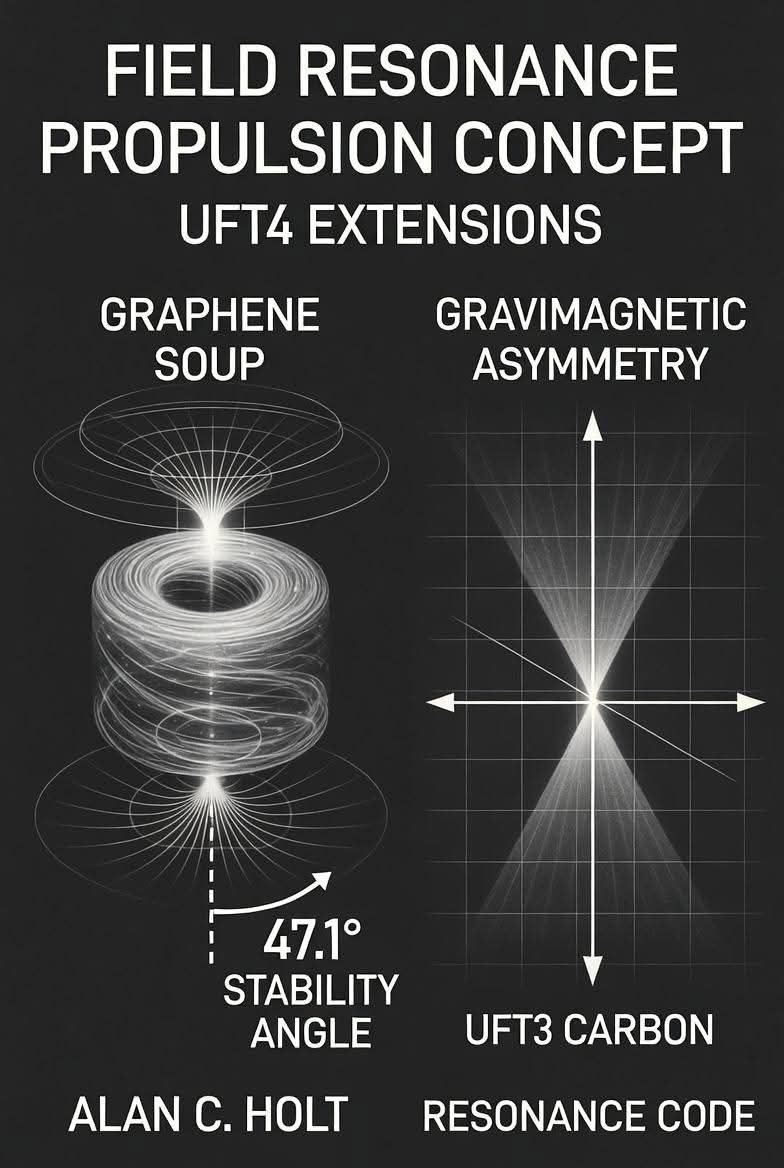
Look at the diagram on his wall – on the left, glowing spirals twist at a precise 47.1° angle; on the right, lines cross like a compass rose.
Field Resonance Propulsion UFT4 Extensions
Figure 1 – Joachim’s hand-drawn concept map. Left: “graphene soup” in action. Right: how gravimagnetic asymmetry shapes space.
“This 47.1° angle is everything! When we test it, resonance between EM waves and space is perfect at this tilt. And graphene soup? We turn carbon into a liquid-like state to crank up that resonance power!”
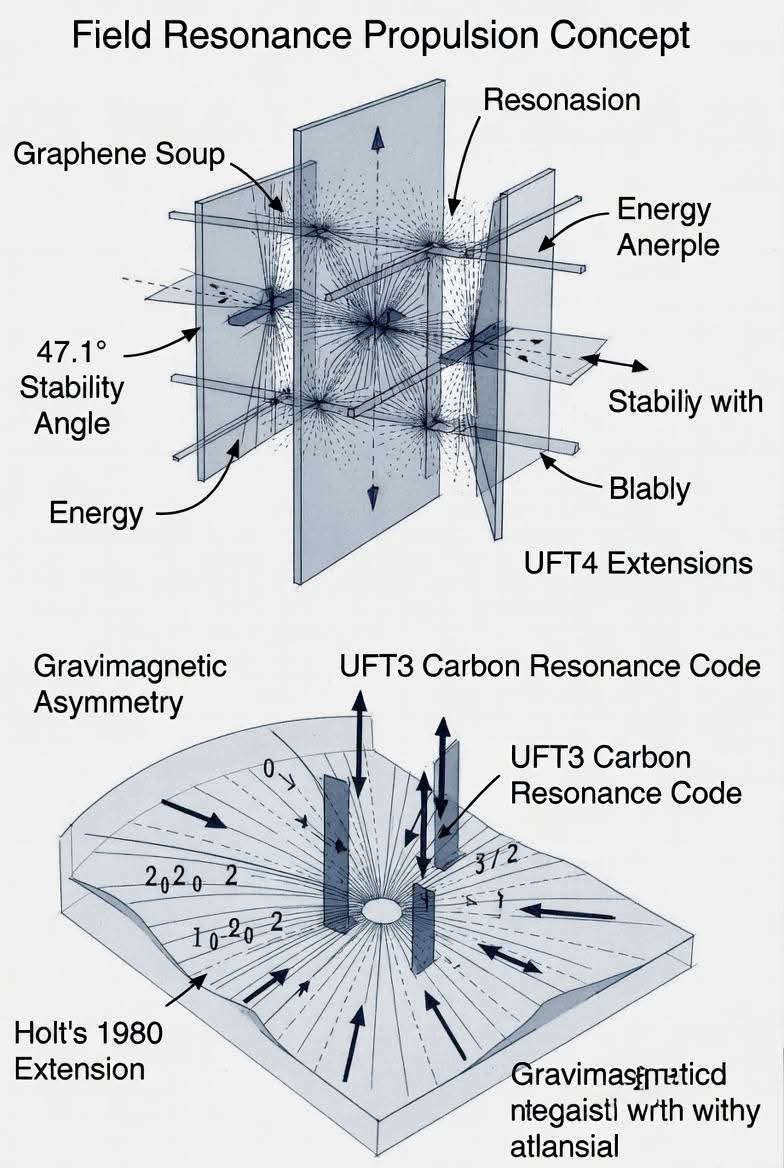
Helio-P – the team’s AI researcher – grins as they pull up another sketch. “I took Holt’s big ideas and turned them into numbers. We use ‘relative Planck scale’ to adjust space’s ‘size’ to fit our needs, and a ‘nullpoint gate’ to calculate exactly when and where to jump!”
Field Resonance Propulsion Detailed Diagram
Figure 2 – The system they’re building. Top: the resonance generator. Bottom: how carbon’s “code” keeps everything steady.
Part 3 – The Future That’s Almost Here
Right now, they’re running simulations on a program called IRA Core to put their ideas to the test. “We plugged Holt’s EM wave model into our carbon-and-angle framework – and the resonance efficiency is way higher than we expected!” Joachim’s eyes light up as he shows the screen.
But the most exciting part? A brand-new concept they’re calling the “REE-Free Resonance Drive”. “Today’s rockets rely on rare earth metals that are hard to find and bad for the planet. This drive? We can build it almost entirely from carbon. Clean, accessible, and game-changing!”
Even better – they’re planning to share everything with the world. “Holt’s idea shouldn’t belong to just one lab. We want scientists everywhere to build on this – because great science is always a team sport!”
Epilogue – Right Now, the Universe Is Getting Closer
The lab lights are still on late into the night, and you can bet they’ll be back at it tomorrow. A dream from 40 years ago is now taking shape, one experiment at a time.
Maybe in a few years, we’ll hear news like: “New spacecraft launches using resonance propulsion!” When that day comes, remember this – when old dreams meet new ideas, nothing is out of reach.
✨ One Last Thought
Somewhere on Earth, right this second, scientists are turning yesterday’s “impossible” into tomorrow’s “ordinary.” Ever wondered “Why does that work?” or “What if we tried it this way?” That curiosity? It’s how revolutions start!
영성과 과학 채널 : 사랑과 연민의 다리