🔬 과학 — 이해를 위한 체계적인 추구
고대의 관찰에서부터 글로벌 협력에 이르기까지
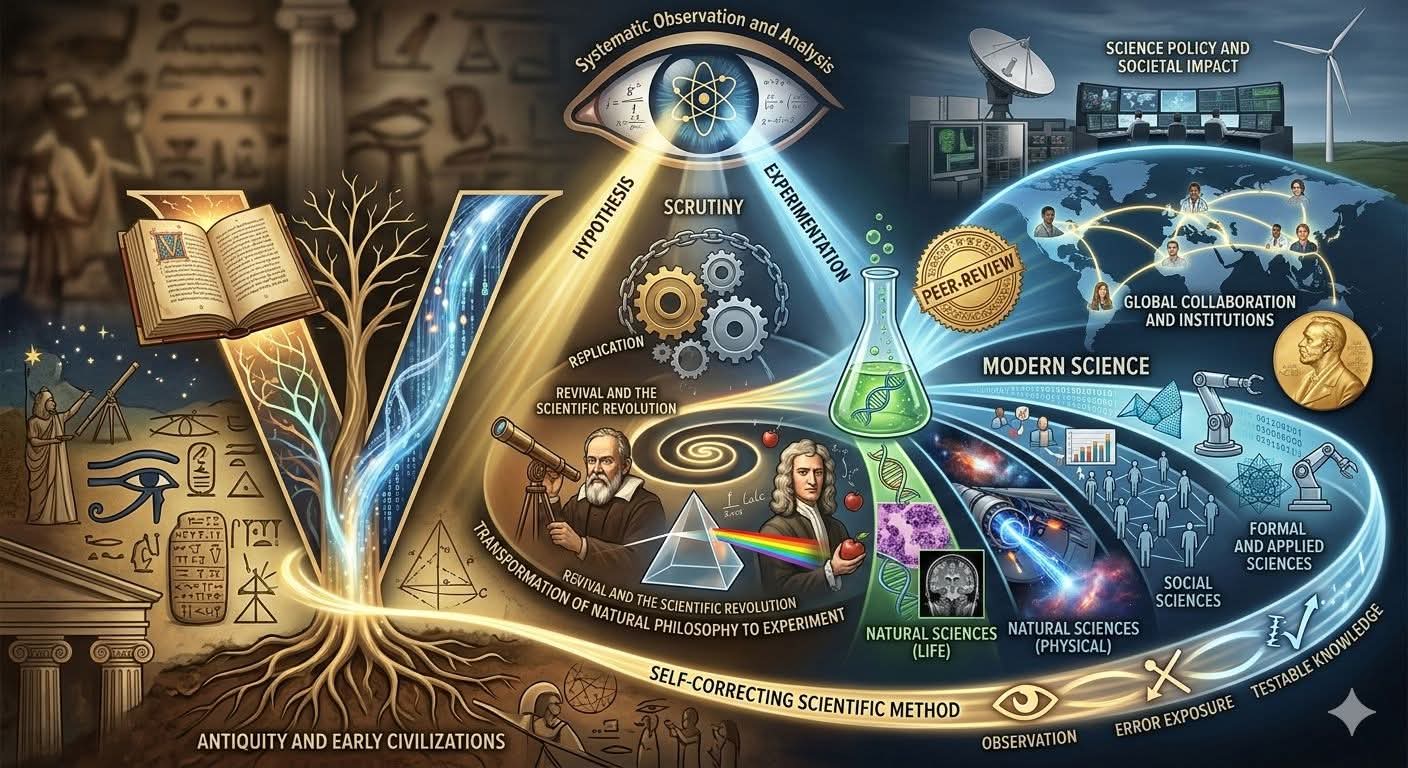
과학은 단순히 발견들의 집합이 아닙니다. 우주에 대한 검증 가능한 가설과 예측 모델을 통해 지식을 구축하고 체계화하는 체계적인 학문 분야입니다. 그 힘은 결론이 무엇인가에 있을 뿐만 아니라, 오류를 드러내고 검증을 받으며 반복 실험을 허용하는 방식을 통해 결론에 도달하는 과정에 있습니다.
현대 과학은 일반적으로 주요 분야로 나뉩니다. 자연과학은 물질, 에너지, 생명체, 우주 구조 등 물리적 세계를 연구합니다. 사회과학은 개인과 사회를 대상으로 행동 패턴, 제도, 문화 체계를 탐구합니다. 형식과학(논리학, 수학, 이론 컴퓨터과학)은 방법론적으로 독자적인 분야로, 실험적 조사보다는 연역적 추론에 의존합니다. 응용과학은 공학이나 의학처럼 이러한 분야의 연구 결과를 실용적인 목적으로 활용합니다.
과학이 현대적인 모습으로 보이지만, 그 뿌리는 고대 깊은 곳에 뿌리내리고 있습니다. 이집트와 메소포타미아의 초기 문명은 수학 체계, 천문학적 관찰, 의학적 관행을 발전시켜 후대의 탐구에 영향을 미쳤습니다. 그리스 자연 철학은 신화가 아닌 자연적 원인에 기반한 합리적인 설명을 추구했고, 인도와 이슬람 세계의 발전은 이러한 지식을 보존하고 발전시켜 현대 수학을 가능하게 한 힌두-아랍 숫자 체계와 같은 핵심 혁신을 선보였습니다.
르네상스 시기 그리스와 이슬람 문헌이 복원되면서 유럽의 학문 탐구가 활기를 띠었습니다. 이러한 지적 부흥은 16~17세기 과학 혁명으로 발전했으며, 갈릴레오와 뉴턴 같은 인물들은 자연 철학을 수학적으로 기반하고 실험을 통해 규율화된 학문으로 변화시켰습니다. 점차적으로 가설을 반복 가능한 실험과 체계적인 관찰을 통해 검증하는 과학적 방법이 핵심이 되었습니다.
19세기까지 과학은 오늘날 익숙한 제도적 특징을 갖추게 되었습니다. 전문 학회, 심사 논문지, 전문 연구실, 체계적인 학술 교육이 등장하며 "자연 철학"은 추측적 추론에서 체계적인 실증 조사로 중심을 옮긴 "자연과학"으로 발전했습니다.
현대 과학은 글로벌 규모로 운영됩니다. 연구는 대학, 정부 기관, 산업계의 연구팀이 함께 협력해 진행되며, 입자 물리학 실험에서부터 기후 모델링에 이르기까지 대규모 프로젝트는 대륙을 넘나드는 전문 지식의 조화를 필요로 합니다. 하지만 여전히 개인의 통찰력이 결정적인 역할을 하며, 혁신적인 발견은 노벨상과 같은 국제적인 영예를 통해 인정받고 있습니다.
과학은 또한 공공 생활을 형성합니다. 그 응용은 의료 체계, 인프라 설계, 환경 정책, 기술 발전에 영향을 미치며, 이러한 힘으로 인해 혁신과 윤리·사회적 고려사항을 균형 있게 조절하며 과학 지식의 책임감 있는 활용을 안내하는 과학 정책이 발전했습니다.
만약 인류가 축적된 지식만을 남기고 다시 시작한다 해도, 과학은 단순히 사실의 보고서가 아닌 새로운 지식을 습득하기 위한 훈련된 방법으로서 없어서는 안 될 존재일 것입니다. 과학의 지속적인 힘은 바로 자기 수정, 협력, 끊임없는 호기심에 있습니다.
과학은 우주에 대한 우리의 이해를 체계화합니다. 그 방법론은 이러한 이해가 계속해서 심화되도록 보장합니다.
한글번역:
🔬 Science — The Systematic Pursuit of Understanding
From ancient observation to global collaboration
Science is not simply a collection of discoveries. It is a systematic discipline that builds and organizes knowledge through testable hypotheses and predictive models about the universe. Its strength lies not only in what it concludes, but in how those conclusions are reached—through methods designed to expose error, invite scrutiny, and allow replication.
Modern science is typically divided into major branches. The natural sciences study the physical world—matter, energy, life, and cosmic structure. The social sciences study individuals and societies, examining patterns of behavior, institutions, and cultural systems. The formal sciences—logic, mathematics, and theoretical computer science—stand apart methodologically, relying on deductive reasoning rather than empirical experimentation. Applied sciences use the findings of these domains to achieve practical ends, as in engineering and medicine.
Though science appears distinctly modern, its roots stretch deep into antiquity. Early civilizations in Egypt and Mesopotamia developed mathematical systems, astronomical observations, and medical practices that shaped later inquiry. Greek natural philosophy sought rational explanations grounded in natural causes rather than myth. Advances in India and the Islamic world preserved and extended this knowledge, introducing key innovations such as the Hindu–Arabic numeral system that enabled modern mathematics.
During the Renaissance, the recovery of Greek and Islamic works revitalized European inquiry. This intellectual revival evolved into the Scientific Revolution of the 16th and 17th centuries, when figures such as Galileo and Newton transformed natural philosophy into a mathematically grounded, experimentally disciplined enterprise. Gradually, the scientific method became central: hypotheses were tested through repeatable experimentation and systematic observation.
By the 19th century, science developed the institutional features familiar today—professional societies, peer-reviewed journals, specialized laboratories, and formalized academic training. “Natural philosophy” became “natural science,” reflecting a shift from speculative reasoning toward structured empirical investigation.
Contemporary science operates on a global scale. Research is often collaborative, conducted by teams in universities, government agencies, and industry. Large-scale projects—from particle physics experiments to climate modeling—require coordinated expertise across continents. Yet individual insight still plays a decisive role, and transformative discoveries continue to be recognized through international honors such as the Nobel Prize.
Science also shapes public life. Its applications influence health care systems, infrastructure design, environmental policy, and technological development. Because of this power, science policy has emerged to guide the responsible use of scientific knowledge, balancing innovation with ethical and societal considerations.
If humanity were rebuilt but retained its accumulated knowledge, science would remain indispensable—not merely as a storehouse of facts, but as a disciplined method for acquiring new ones. The enduring strength of science lies in its capacity for self-correction, collaboration, and sustained curiosity.
Science organizes our understanding of the universe. Its method ensures that understanding continues to deepen.
---
#Science #ScientificMethod #HistoryOfScience #Research #Knowledge #Innovation
#과학 #과학적방법 #과학사 #연구 #지식 #혁신